
Hello, and welcome to the first instalment of the herbs and healing series!
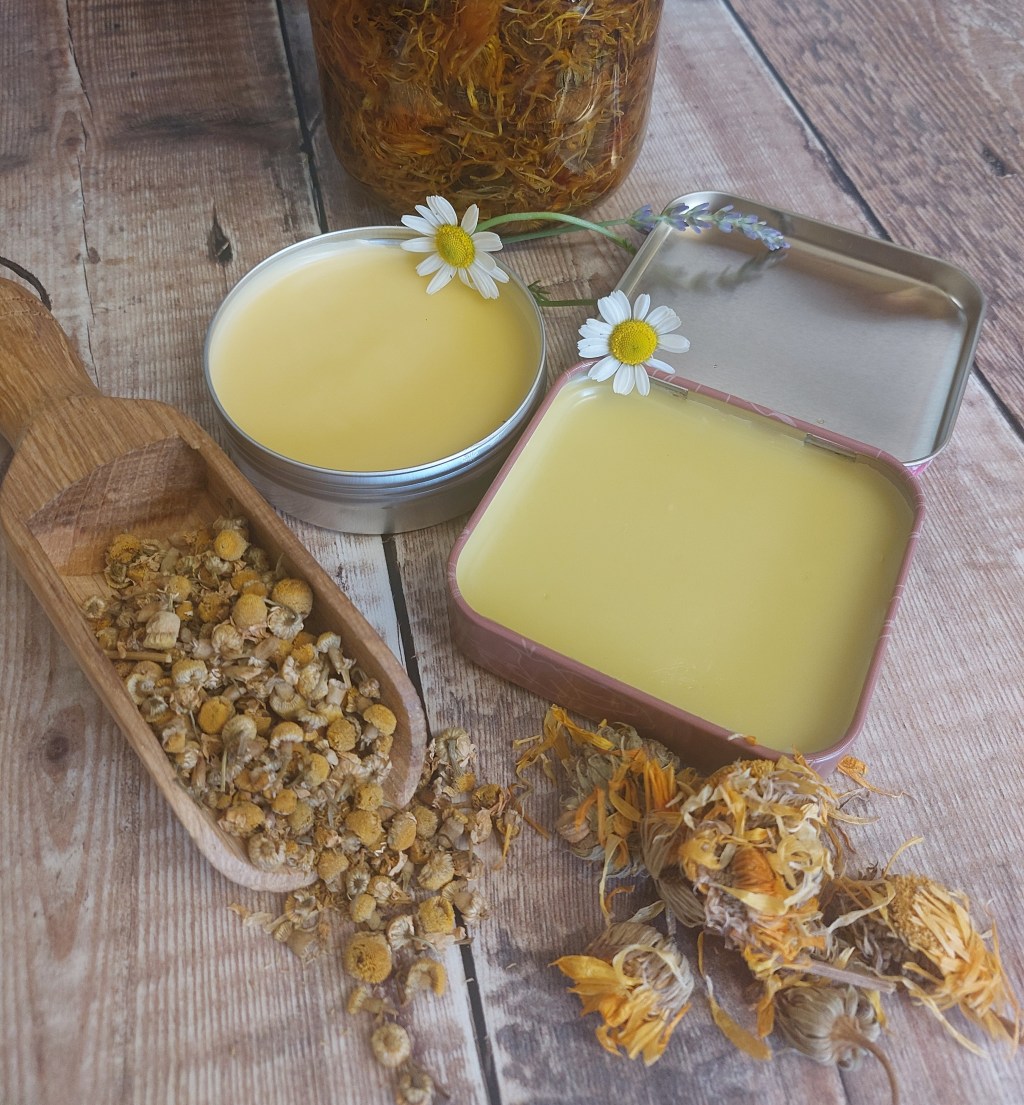
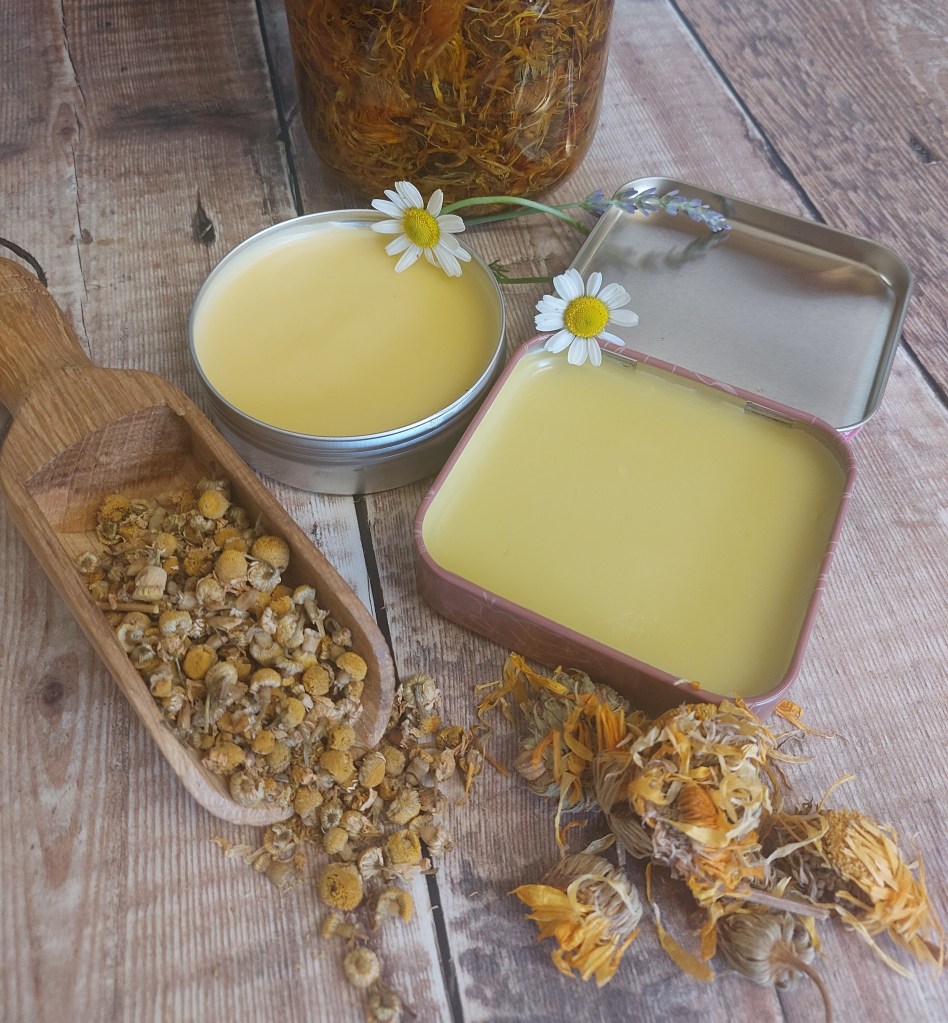
This week, I am going to be demonstrating how to make a chamomile and calendula salve for dry and aggravated skin!
If you’re new here, my name is Zanna and I am a Folk Witch, Birth Doula, and Priestess. I am also a folk herbalist and currently studying my herbal foundation, in the hopes of one day training as a full medical herbalist. In many ways, I am a modern day ‘wise woman’ figure.
As a Witch and Priestess, I place a lot of emphasis on community service. For me, this often takes the form of volunteer work as a Pagan hospital Chaplain. Doing free talks and workshops at local Pagan moots, informative podcasts, and of course, blogging.
Diary Of A Folk Witch is a learning platform that leads by sharing living examples of folk witch life, instead of formal lectures and courses alone. The benefit of this is that you get to see it all. People often have a notion that witchcraft is just the act of casting spells. Or going about in the dead of night to perform ritual – this could not be further from the truth! For the vast majority of practicing Witches, their witchcraft is a way of life! A way of life that crosses over into every area of their day to day living and lifestyle. And this is what I share with you. I do however, still share workings and rituals, but also so much more!
So please join me as I launch this new extension of the free blogs that I offer on the platform.
Introduction.
If you’re anything like me, you might have tried and tested a fair few make-it-yourself herbal remedies at home. If you’re definitely like me, chances are that quite a few of these remedies didn’t turn out how you expected. But hey, that’s fine! It’s all part of the learning process, learning any new skill takes time and practice. Over the years, I’ve perfected many tried and trusted recipes, and I’m going to start sharing these with you!
That being said though, some herbal remedies can be a little complicated or costly. So, to start this series, I thought that I’d kick off with one of my most simple, yet effective salves!
How I Came To Create This Salve.
This chamomile and calendula salve was initially created out of pure necessity. As a busy mum of five, I often find that it’s beneficial to have a cupboard well stocked with balms for bruises, or herbs that can be used in poultices for cuts and scrapes. However, when it came to childhood eczema, I had only ever really needed the bare basics of oils or creams to treat it. It was not until my son was born, and within a few hours of birth, started to show signs of angry eczema, that I realised coconut oil alone was probably not going to be enough.
After a few weeks, my new babies eczema got a lot worse – And I mean a lot worse! Despite being breastfed (and therefore, we could rule out a dairy/formula allergy) my son’s skin was not only dry, but splitting because of how dry and tender the skin was. Creases like my sons wrists and feet were splitting and bleeding too.
At this point, I did what any mother would do, and I took my then eight week old baby to the Dr, who did what Doctors usually do in this situation…
Offered me dietary advise in case I was consuming something my son was allergic too via my breastmilk, and prescribed a steroid cream for my sons skin. Which is fine for short term use, but not really safe or ideal for long term use.
Daily, I would apply the cream, and it did not work – if anything, his skin got worse! To the point that it looked like my baby had second degree burns on his face!
It was time to turn to natural medicine. If dietary changes and medicated creams were not working, natural salves and oat baths might. So I set about doing very careful patch tests of various herbal infused oils on small areas of my son’s skin – this is really important! especially with such a young child, and it is not something I would advocate for other parents to do unless they were experienced and knew what they are doing.
Eventually, I found that my son responded well to infused calendula and chamomile oils. Which was handy, because I knew exactly what was in these oils as I had infused them myself earlier in the year. Therefore, there were no nasty chemicals to worry about.
It took time and perseverance to get the ratios just right for the salve, but after a few attempts, I came up with the recipe I now share with you today. In fact, it works so well, that I get friends and family asking for me to make some up to treat their various skin conditions. From eczema and psoriasis, to tender stretch marks on mummies’ tummies.
Within twenty four hours of applying the salve to my son every 4-6 hours, the redness had subsided. Then, about forty eight hours or so, his skin was showing signs of healing. By the end of the week, other than his skin being a little dry, you would not have known that only a week before patches of his skin was so bad it looked like bloody and oozing burns.
Now, it’s important to note here, that I make no claims that this salve is a cure all for eczema. That would be absurd! Especially as the condition eczema is so variable from person to person. What helps one persons eczema, may not help another, it entirely depends on what is causing the skin to react. For some, this may be a gut issue – some would argue that all eczema stems from the gut, but that’s a topic too vast to cover today. For others, their eczema could be a food or environmental allergy. Sometimes, even stress can cause skin conditions. Sadly, sometimes, the treatment of severe skin conditions is a lengthy case of trial and error.
This is a really simple and straightforward herbal remedy that you can try for skin complaints, but it is really important to be careful. Therefore, I offer the following cautions.
- Just because a recipe is ‘natural’ or organic, does not mean a person cannot cannot have an allergic reaction. It is always wise to do patch tests with ingredients individually before making a remedy, and then again after it has been formulated with all of the other ingredients.
- All of the ingredients in this recipe are considered to be safe for children and adults. However, if there are any underlying health conditions, this could possibly undermine this.
- As the author of this blog, I do not take any responsibility for any allergic or negative reactions to this remedy. If you are unsure of a remedy or health condition, always seek professional advice. In this case, from a Dr or Medical Herbalist.
How To Infuse Oils.
Although most of the people reading this blog, will know how to infuse oils, I thought it might be helpful to add in this section for those who may not have done it before.
My method is simple, I take a one litre jar, and fill it half way with the herb I am wanting to infuse, and the fill the jar to almost the top with my choice of oil, in my case, this is nearly always organic extra virgin olive oil. From there, I can do one of two things, I can either warm infuse or cold/time infuse.

For a warm infusion:
With the lid on loosely, place the jar of oil into a water bath (an instant pot or slow cooker are ideal), ensuring that the water level is about half way up the jar, and then leaving the oil on the ‘keep warm’ setting for between 12 and 24 hours. This is the quickest way to infuse an oil with herbs. It is really important to use the lowest heat setting so that you do not cook the herbs. In some cases, you may need a stand inside your cooking equipment of choice. This stops the oil burning from the heat at the bottom of the pan.
For example, the instant pot comes with a little steel stand. You you can use this to put in the bottom of the steel pot, so that the jar is not directly on the hot surface. Alternatively, if like me, you make a lot of herbal infusions and remedies, you could perhaps invest in a herbal infusion machine. Though these are very expensive, and I personally do not have one.
For a cold/time infusion:
Simply take your jar and fill it half way with your chosen herb. Then fill the jar with your oil to almost the top. Set aside for about 6-8 weeks, ideally out of direct sunlight. The herbs will naturally infuse in the oil over time.
Once your infusion has occurred – through either of the above methods, strain the oil into either a Kilner type bottle or new jar. Make sure you squeeze all of that lovely medicine out of the herb pulp. You can use the back of a spoon to do this. Simply press it against the herbs so that the oil strains through the sieve.
Ingredients For The Salve.
- 55mls of coconut oil.
- 55mls of chamomile infused oil.
- 30mls of calendula infused oil.
- 35gs beeswax.
- 8 drops of lavender essential oil.
- 8 drops of Roman chamomile essential oil.
- Two 100ml jars or cosmetic tins to store your salve in.
Instructions.
- Using a water bath, or Bain Marie method, melt you beeswax.
- Once your beeswax has melted, add in your coconut oil. Because this is a semi solid oil, it will melt very quickly. You may notice that the beeswax goes a little milky or cloudy – don’t worry. This will clear as the oils incorporate into the wax.
- Next, add your chamomile and calendula infused oils to the beeswax, and stir. At this point, you could potentially add in some kitchen witchery or healing workings by reciting any prayers, affirmations, or charging the oily brew for healing. You could also add in some sympathetic magic such as stirring the mix sunwise to invoke healing and light. Or anticlockwise to unwind the illness or affliction – it very much comes down to you, the practitioner, and what your rules and preference are here, regarding sympathetic magic ‘rules’.
- Once all of the oils and wax are fully incorporated, it is time to pour the liquid salve into your jars or cosmetic tins. Do this carefully as your salve will be quite hot! Carefully pour the mix into the tins.
- Add four drops of each essential oil to each 100ml tin of salve, and using a cocktail stick, gently stir the essential oils into the salve. Although the salves are hot, they should not be so hot as to destroy the aromatics of the oils.
- Allow to cool and set. Depending on your environment, this may only take a couple of hours. But obviously, if you are in a warmer area, this may take longer. You can speed this process up by placing the salves in the refrigerator. But allow the salves to cool for at least half an hour before you move them to the fridge.
- Once set, you can put the lids on and use! I find that these salves store really well, for a year or more if in the right environments.
For using this salve, you can apply as and when you like on dry skin.
However, for certain skin conditions such as eczema, you may find that applying this salve every 4-6 hours beneficial. But only if the skin condition and person tolerates this treatment. It is helpful to note, that where lavender (Lavendula angustafolia) is usually seen as a calming a mildly sedating herb, in some people and children, it can act as a stimulant in high doses. This can, in some rare cases, keep children awake at night. But this is uncommon, especially as this recipe only calls for four drops per 100ml tin.
I hope you enjoyed this months first instalment of the herbs and healing series! If you did, feel free to drop me a comment, or follow me over on Facebook and Instagram. I also release a podcast every Wednesday, and operate a premium content subscription service, dedicated to sharing genuine folk witchcraft to all seekers.
From the time, mists, and distance between us, blessings from me to you.
Zanna
 Diary of a Folk Witch
One response to “The Herbs And Healing Series: Chamomile & Calendula Salve.”
love this, zanna!! definitely going to try this soon 🩷
LikeLike