As long as there has been a practice of Witchcraft, so too does there seem to have been a use of pins, needles, nails, and other sharp, pointed, and easily accessible tools within the art.
Unfortunately though, when we think of pins in magick, our minds often turn to the more malefic forms of Witchcraft, such as the poking of pins into poppets in order to cause harm. One popular association with the use of pins and dolls is of the African American Vodou doll. Both Hollywood and white media have given the legitimate religion that is Vodou an unfair and unrealistic representation. For it is my understanding that just like the British and Celtic Folk Magick of which I practice, pins in poppets and effigies can be used for good as much as they can be used for ill within the Vodou practice.
Both pins and needles have been used within witchcraft and the sympathetic magick of folkways of Britain and Ireland for hundreds, if not potentially, thousands of years.
It’s use is referenced in both the Salem and the Lancashire (Pendle) Witch trials. Though not British, the Salem colonies and the accused were predominantly of British birth or descent, therefore this form of magick and accusation is extremely relevant to this blog which, as usual, will be looking at the magick and folkways native to both Britain and the Celtic lands.
In this weeks blog we shall be looking at references of the use of both pins and needles within witch trials, old spells, and in the use of sympathetic magick.
We will also briefly discuss the politics of poverty and how this has influenced folk magick, looking at why pins were so sought after for both general and magickal uses.
In total, we shall look at;
- Some of the types of pins and needles used in Witchcraft, as well as other sharp and pointed tools.
- Examples of pins and needle magick in protective workings
- Examples of pin magick for harmful workings
- Examples of healing pin and needle workings
- Example of manifestation pin and needle workings
Politics, Poverty, Pins And Needles.
One of the things I absolutely love about folk magick and traditional style Witchcraft (both historically traditional, and of course the more modern interpretations and practices), is that it is relatively free of the pomp and theatrics of it’s more middle class and aristocratic cousin, that is high magick.
Within traditional Witchcraft and Folk Ways, the local cunning person or Witch, didn’t seem to have a huge ornate altar, expensive and imported herbs, gums, and resins, or expensive coveted occult books. What they did have was a connection to the land, it’s spirits, and a very sophisticated system of sympathetic, like for like, magick that appears to have been passed on largely via a blend of both oral and learned in person traditions. Something that was hugely important when you were a ‘commoner’, likely poor, possibly illiterate, and were at the bottom of the strategically created British class system.
Folk magick and Traditional Witchcraft are often described as ‘get things done magick’ and also as a ‘survival tool’ for the then lower classes.
I agree with this notion, after all, if you’re living in a society where your very existence can be wiped out by what today’s society would view as a fairly minor or moderate illness (treatable with antibiotics or antiviral medication), or where infant and maternal mortality was so high (largely due to poverty and a lack of hygiene awareness), you’re more likely to turn to Witchcraft for assistance and protection. The same applies to when the justice system has failed you, or your landlord or local authority has unfairly increased your taxes or rent.
In some ways, Folk Magick has not changed. Where we do live in a society that has a social benefits system to supposedly fall back on in times of need (in theory that is, the current Westminster based Government and Department Of Work & Pensions are making it increasingly difficult for sick, disabled, single parents, carers, and the unemployed to access this support) and we do have access to a wonderful National Health Service, it cannot be denied that Britain is facing a poverty crisis, with homelessness and in work poverty at an all time high. Combined with other social injustices, is it any wonder that more and more people are turning to Witchcraft to help them get through such turbulent times? This is not just an issue isolated to ‘Great’ Britain, Witchcraft is on the rise throughout the Western World.
In fact, it was only two years ago that we saw photographs of President Trump Poppets flood the internet, with strategically placed pins. More recently, this type of malefic technique has been used upon the Russian President Vladimir Putin, after his unfounded and devastating invasion of Ukraine.
This form of cursing poppet magick is in no way new, there are some fantastic examples of political poppets and more discreet/humorous ‘pin cushions’ housed at the truly magnificent Museum of Witchcraft and Magick (Cornwall, England).
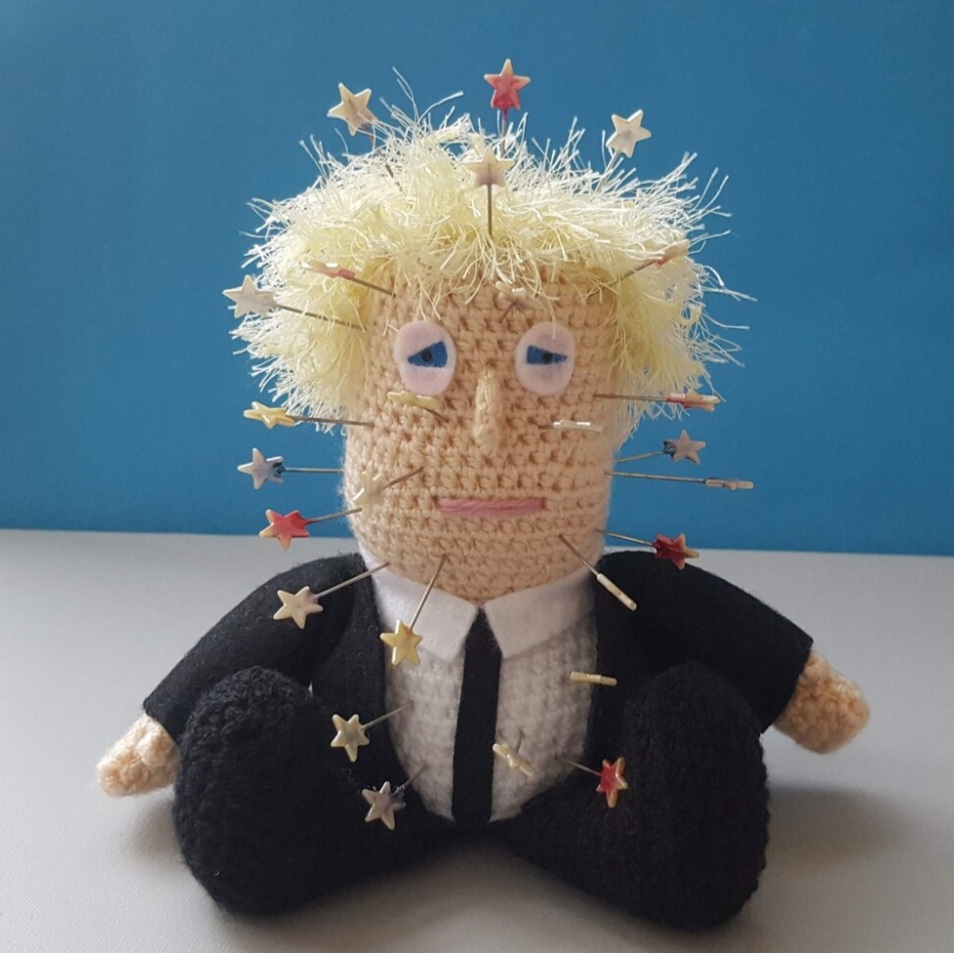
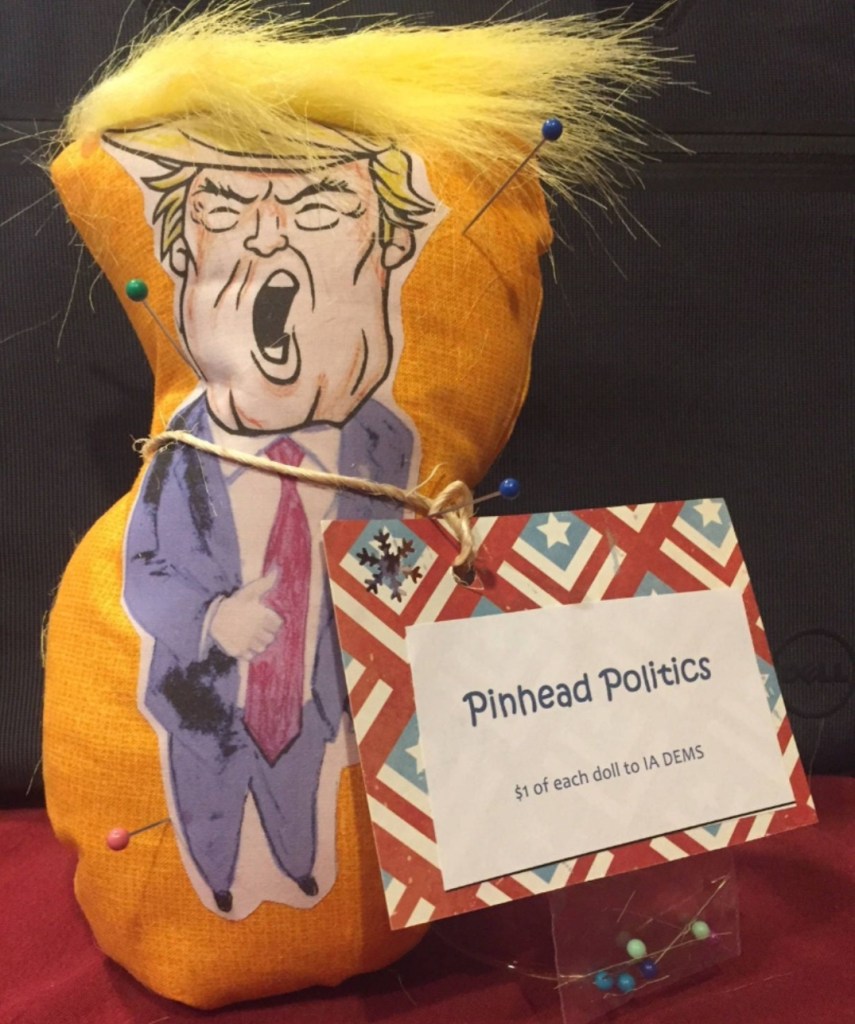
Pins have a long documented use within effigy magick, it is a clear and strategic way of focussing energy and intent into one area of the intended.
As well as the Poppet, another example of pins, and other sharp objects such as blackthorns, nails, needles and broken glass would be inserted into Witch Bottles.
Witch Bottles are a particular type of protective apotropaic magick, used to not only protect the user/maker of the bottle, but to inflict excruciating pain upon an attacker. Within the sealed Witch Bottle, a boiled up mixture of urine and sharp objects (such as bent pins or nails), dirt, gravel, graveyard dirt etc would be found.
The bottle would then be buried or interred within a small space, often upside down and representative of the Witch’s bladder. It was then believed that if a Witch ‘fired’ at their victim (or had already done so), that their dark magick would be returned to them. The pain caused by the Witch Bottle would be so intense that the ‘dark’ Witch in question would either stop their own blasting or would come directly to their victim and both beg forgiveness and the dismissing of the Witch Bottle.
This may sound extreme to those reading this who perhaps like to err on the side of ‘white magick’, but it should at least be understood that in days where there were limited ways of settling neighbourly disputes, or proving witchcraft had taken place, it could be difficult to get any form of ‘official’ support, let alone justice and protection. After all, how do you afford legal representation when you’re poor, and how can you prove an invisible crime?
This lack of support and assistance sometimes meant that the everyday person, even the most religious of people, would go and consult their village wise person, witch or cunning folk.
If this was not possible, then it was not unheard of to turn to witchcraft themselves. Though it is important to note, that these actions were not always considered ‘witchcraft’.
Even in recent years, i’ve noticed people make use of ‘Folk-Ways’ and then justify it by arguing that their actions are not ‘witchcraft’ (witchcraft being somehow believed to be bad or nefarious), that they are just protecting themselves, or bringing about healing, sometimes describing this as the same as what their Granny used to do, or ‘prayer in action’.
However, in reality, no matter how finely you split the hair, Folk Ways are still usually acts of sympathetic magick and therefore fall under the umbrella of witchcraft. It’s just some people are not comfortable with the ‘W’ word, especially if they are practicing Christians, or don’t want to be viewed as a social outsider. It is interesting, as in some ways, this is social politics and social psychology in action.
If we circle back to politics and poverty for just a moment, we can see why people, especially historically, relied so much upon the every day items around them for their magickal workings. A bellarmine jug to represent a bladder, and therefore used for a Witch Bottle. Ribbons or torn cloth to bind. Poppets made of soil, clay or wax and then coated in honey to sweeten another persons disposition. Or pins to fix intention (good or otherwise). This like for like enactment not only made folk magick accessible to the lower classes, but was easy to perform and extremely effective in it’s outcomes. Even today, where the average western Witch has access to any number of tools, herbs, resins, and even bones, all at the click of a button, we often still find ourselves foraging locally for more meaningful ingredients. Or rummaging through drawers at home to see what we can make use of in an instant.
Types Of Pins, Needles, And Pointed Tools.
Dressmaking Pins: Dressmaking pins are probably the most used of all pins, needles and pointed implements within witchcraft. They are fairly easy to obtain and straightforward to use. In fact, it was an argument over pins that instigated the infamous Pendle Witch trials in 1612. Young Alizon Device was walking along a country lane in the forest of Pendle, on her way to Colne, when she happened upon an elderly Peddler man, John Law.
Alizon was used to begging and scraping by on a meagre earning, so she thought nothing of begging some pins from John the peddler. It was only when he refused to open his pack that Alizon lost her temper and openly cursed him. Whether it was the power of the curse, or the stress of the altercation, John Law collapsed, seemingly from a stroke.
It was this incident, combined with Alizon’s naivety in her offering an open confession (presumably believing that she would be given a lighter sentence for doing so) that spiralled into ten people, including most of Alizon’s immediate family, to be imprisoned on the charge of witchcraft, and later hung.
It is unknown why Alizon wanted pins so badly, it could have been for innocent home industry workings, or even to sell on again for a small profit.
However, given that Alizon was from a family of notorious local Witches, headed by her grandmother, Old Demdike (Elizabeth Southerns), it is also not entirely unreasonable to wonder if Alizon wanted the pins for a more occult nature. We know that both the Demdike and the Chattox Witch clans worked with effigy magick, and that Elizabeth Demdike, Alizon’s mother, supposedly made a ‘clay picture’ of a local named John Robson, who later died. Therefore it is entirely possible that Alizon wanted the pins for witchcraft.
Sewing Needles: Sewing needles are a fantastic tool within witchcraft, but do tend to be used in markedly different ways to pins. Where pins are primarily used to focus energy into place, the sewing needle is often used to bring together or to bind. A good example of this would be the sewing of charm bags, the creation of patchwork quilts (or quilting magick- something my mother was very interested in), or even the adjusting of poppets, fetishes and ‘Babby-Pets’. (Note: I shall discuss the Babby Pet in a later blog, but it is a particular kind of Poppet used for self development, protection and decoy work).
I have seen Poppets opened up to have things inserted into, such as crystals or herbs for healing, and then sewn back up again with surgical style suturing!
The suture stitching itself, imitating medical skills, acted as another form of sympathetic magick, a way of additionally looking after and bringing healing to the intended. That being said, I have also seen Poppet examples where the mouth of the Poppet has been sewn shut in order to stop the intended slandering and gossiping. On this occasion, the Poppet’s hands and legs were crossed and sewn together – a magickal and symbolic way of binding and tripping the intended.
Bone Needles: Bone needles can be used much the same as normal needles. However, on doing research over the last year on the use of pins etc within magick, I have noticed that bone needles tend to be used more in representative magick. This is probably because most bone needles are not always very sharp and therefore when they are used, it’s more for symbolic reference. That being said, I do know of one Witch who says she likes to use a sharp bone needle in both necromancy and ancestral veneration. This is presumably because of the link between bones and the dead.
Another use for bone needles is for both basket and net making. This can be another way of connecting with our ancestors via the re-creation of old and ancestral skills.
A further use for bone needles is to leave it in a grave of an ancestor and then bring the needle home after a set period of time in order to use within workings. I have not done this, but it does seem to be an interesting way of harnessing shared powers and assistance from one’s ancestors.
Nails And Tacks: Both nails and tacks are used much in the same way as pins and so are also used to focus energy into a specific area of a photograph, poppet, the ground, etc.
Another interesting use for both nails and tacks is to push it into the footprint of an enemy or errant lover, in order to cause mischief for the enemy and the binding of an unfaithful lover.
Nails can also be pushed into the grave of a criminal for the twenty four hours of a full moon and then used in curse magick. Whereas a nail pushed into the ground where a river or brook meets a bridge can be used to draw upon both healing and cleansing energies.
Another form of nail magic is the act of taking three small nails and hammering them into the heel of a loved ones right shoe, in such a way that the three nails form a triangle. It is believed that the three nails in the heel of the right shoe will keep the owner of the shoe always on the ‘right’ path in life and will be protected by the ‘Father, Son and Holy Spirit’.
Another variation of this is to nail three nails into ones front door frame for protection. The nails must be blessed with holy water and then driven into the doorframe in order to prevent ghosts and demons crossing the threshold. This is a relatively common folk practice, especially amongst those who are of Irish Catholic descent.
Witch Pins: The Witch’s Pin is a particular nail or other large iron rich pointed tool that can be used to carry energy from one place to another. For example, the Witch Pin can be left in the ground of a stone circle, or known place of healing to absorb that landscapes energy and then be transported back to the Witch’s home to then use and direct, in a similar way to a traditional wand. A Witch Pin can draw upon the energy of anywhere the Witch wants to work, and be used for both good and ill. The pin, like the nail can also be driven into an enemy’s footprint in order to cause harm, or somehow hinder them. It can also, theoretically speaking, be pushed into a grave so that you can either control their spirit or supposedly stop them crossing over. However, this is not something I suggest anyone tries as it is both dangerous and cruel.
Witch Pins can vary in style, I have seen some made from coffin nails, railway spikes, and even the prong of an old broken gardening fork! This waste not, want not attitude in traditional witchcraft and folk magick is truly fascinating and frugal. As one local Lancashire Witch said “It doesn’t always matter what the tool or the ingredient is, as long as you believe in it, and it’s relevant to your working, then it will be all right”.
My Witch Pin is somewhat ornate and set with a haematite. A little pretty for my usual liking, but it is a good size, sturdy and a beautiful gift from my husband. My original Witch Pin is a sharp tine from a burned pitchfork, prepared by both myself and my husband.


Rose Thorns: Rose thorns have been known to be used in love magick, predominantly in magick where a lover has been scorned and they either want a lover back or they want to make sure someone has a broken and pained heart.
Bramble Thorns: One working taken from my own family folk ways uses the bramble thorn as a protective quality in a apotropaic like working to protect one from the evil magick of another. To do this, a flat clay poppet must be made (often with a simple gingerbread man style cookie cutter). Within the clay is the hair of whom is to be protected, and from the back of the clay poppet, Bramble thorns are poked through the poppets head to form a crown, the hands (to fight back) and feet (to kick back).
When the thorns are poked through the back of the poppet, it exposes the sharp point of the thorn in the front, thus creating a sharp defence. I can attest to this being a very effective working, and anyone attempting to fire at you once, will not usually try a second time because they are usually put off by the amount of bad luck and misfortune that they receive. Bramble has an abundance of folklore and witchlore around it’s many protective qualities, and it is a plant I work heavily with!
Blackthorn Pins: Blackthorn pins are more often than not used in what many call ‘blasting’ magick, but as well as this, they can be used in counter-curses too. An example of this would be that to curse or cause harm to another, blackthorn pins should piece a persons image on a photograph. However, to protect a person, blackthorns should be pieced around the edges of a persons photograph to form a wall of protection around them. Blackthorns can also be harnessed to form a protective and power enhancing Witch’s Ladder.
Examples Of Pins And Needle Magick In Protective And Counter Curse Workings
The Witch Bottle:
“To remove a curse using a Witch Bottle, put some of the bewitched person’s
water (urine) with a quantity of pins, needles, and nails into a bottle, cork them up and set them before the fire. A 1689 record of this procedure is very similar.”
‘Stop the urine of the patient close up within a bottle, and put into it three nails, pins or needles, with a little white salt, keeping the urine always warm’.
“The author says the recipient of the spell will be ‘grievously tormented, making their water with great difficulty, if at all.’
‘The British Book Of Spells And Charms’ by Graham King.
The Blackberry Hoop:
Around the time of May Day celebrations, go to the local woods and find yourself some ‘awake’ and sharp bramble hedgerows. Once there, say;
“Oh blackberry of the hedgerow, friend of the poor and enemy of the devil.
lend to me your spirit so that I might drive away all evil, harm and illness”.
If you feel the bramble accepts your request, cut yourself a good length of the sharp vine and without gloves, form yourself a good sized hoop. The hoop must be made by only the aid of your hands, no string or binding to hold the hoop in place. So, you will need to carefully weave the bramble in and around itself- without causing any cracks or breakages. if you cause a crack or a break, you must start again.
Once formed, thank the bramble by pouring a libation of some sort upon the ground in which it grows. Wine, milk and honey, or menstrual blood mixed with water (menstrual blood, as well as a woman’s placenta is well known for helping plants grow and thrive!).
Take the bramble home and hang it by your front door for protection. You can also adapt it’s use throughout the year by hanging it above the bed of a unwell person, or one who is experiencing nightmares or being ‘hag ridden’ (sleep paralysis).
An old family working from my own line, Zanna Buxton-Kelly.
Examples Of Pin Magick For Harmful Workings
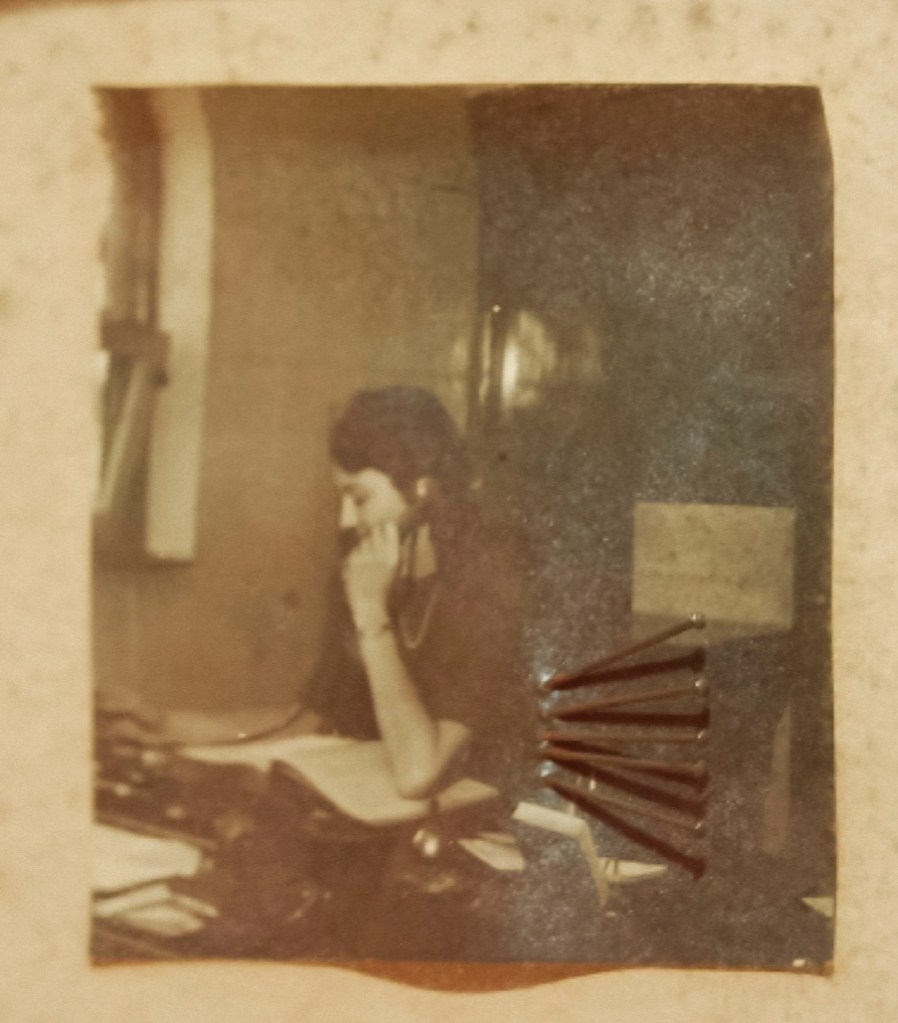
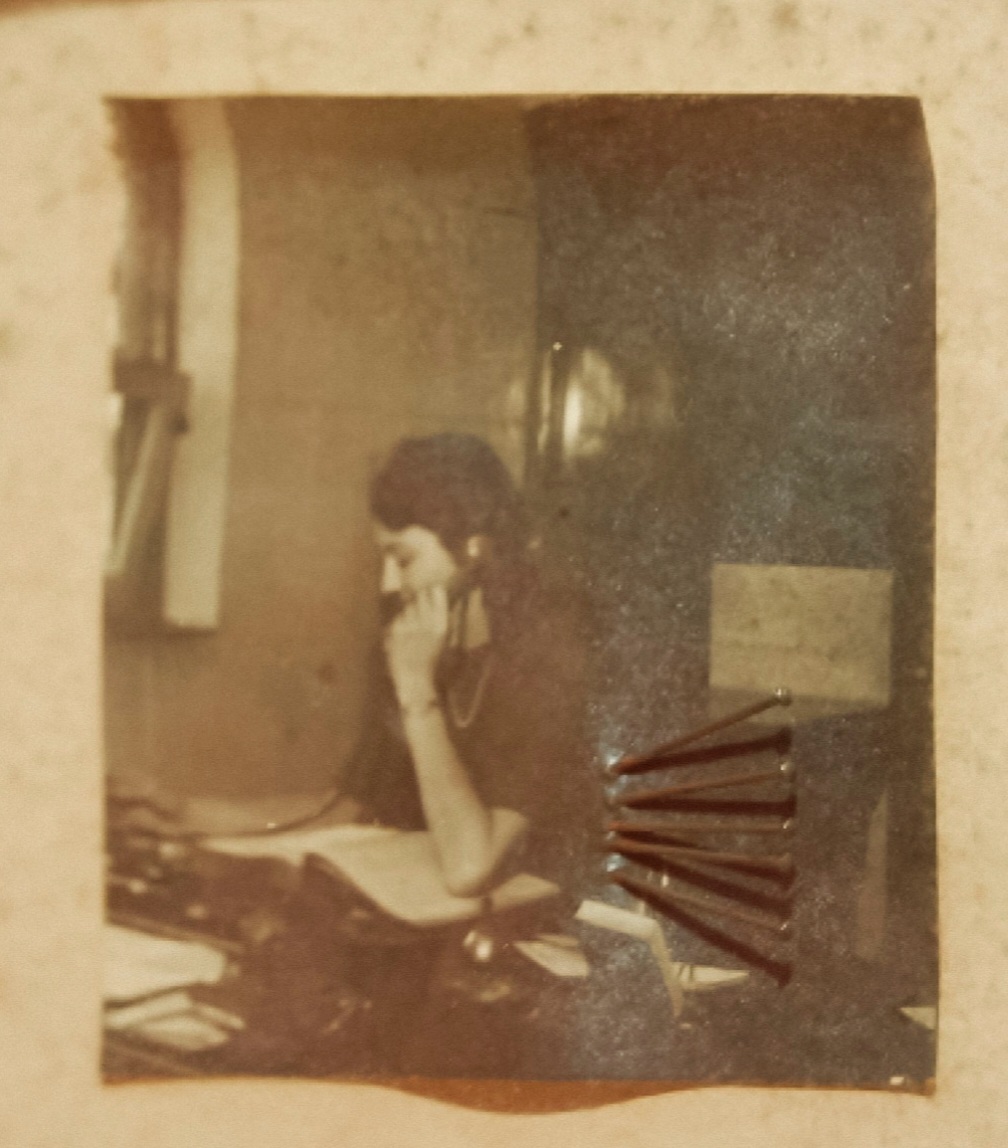
This is a particularly interesting example of a curse from possibly the 1940s.
In an age where photographs were becoming more and more accessible for everyone, not just the wealthy, we can see Witches are beginning to utilise these stills in order to perform magick.
Original text from Cecil Williamson states:
“This lucky find, tucked away in the back of a local government office filing cabinet, speaks for itself. Someone had a cause to punish the nice looking lady secretary. One wonders what it was – dislike, envy, or a lovers quarrel”.
One of the things that has always struck me about this particular example of malefic workings is that it reminds me of the tarot card, the Five Of Swords.
This is my own interpretation and I by no means declare it to be true to the person’s intentions who made this working.
The Five Of Swords is all about conflict, someone has the upper hand (in this case, the Witch doing the working) and the other is left battered, bruised and attacked.
The Five Of Swords also encourages the seeker to pick their battles carefully, and this may be what the Witch has done. Perhaps they knew they could not confront their intended directly. That it would not work or would leave the Witch in a vulnerable position. But attacking in a more covert and sly manner may lead to a more victorious outcome.
Another interesting thing to note is the positioning of the pins. They follow the path of the spine. It could be that the Witch may have wanted this secretary ‘stabbed in the back’. Perhaps the secretary was an unpleasant person who betrayed another’s confidence, and therefore the one performing the working wanted to turn the tables. Or Perhaps the Witch wanted to cause the lady back problems or a lack of support. After all, our back provides us with a lot of support and without good back and spine health, we are often left with poor mobility and unable to work. So perhaps the Witch wanted this secretary out of a job.
Unfortunately, we shall never know the exact details of this Witch’s intentions.
Example Of Healing Pin And Needle Workings
Sexual Healing Working:
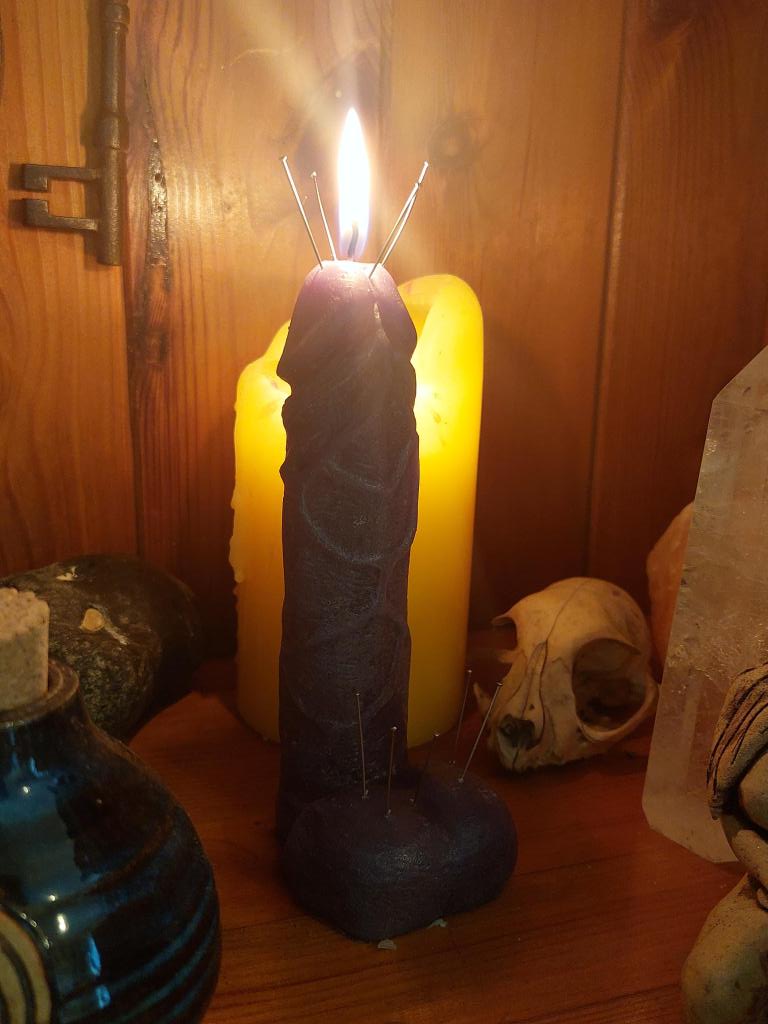
The above photo may look very dramatic and ill-intentioned, but it is actually a healing candle.
This is a replica of a working carried out for a gentleman who was struggling with intimacy issues due to stress and having been in an emotionally abusive relationship. This candle working sought to re-impower him, protect him from future negative relationships and give his libido a boost! Hence the strategically placed pins.
A Witch Bottle For Healing:
“Place within a bottle good amounts of bay leaves, benzoin, juniper berries, lavender and rosemary. Then add some hair and nail clippings of the patient, and nine best pins to drive away the illness”
‘Traditional Witchcraft, A Book Of Cornish Ways’ by Gemma Gary.
Examples Of Pins And Antlers Used In Manifestation Workings:
Prickers In Weather Magick.
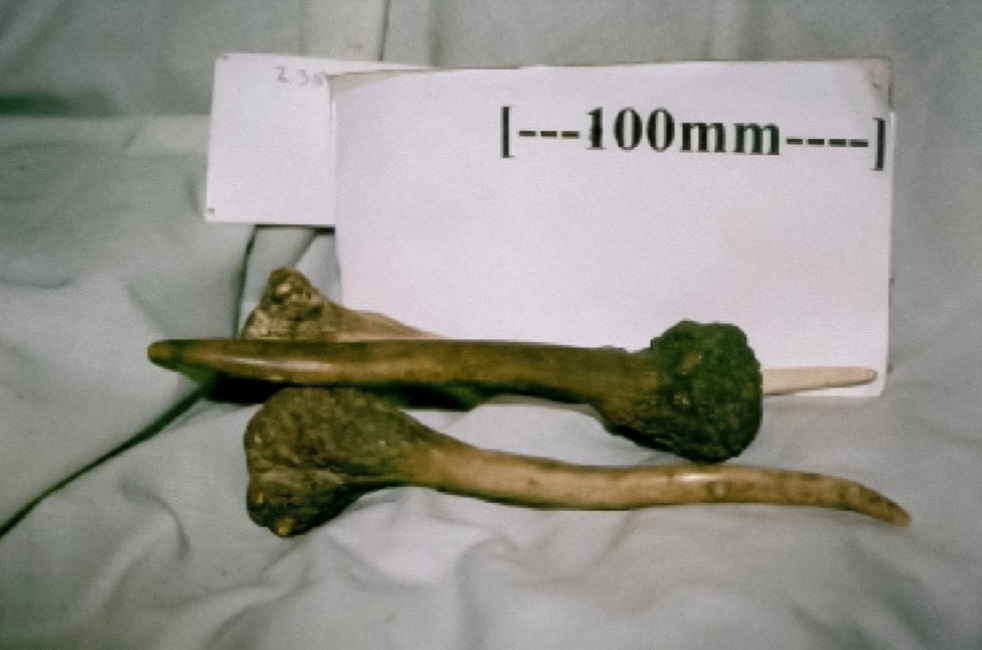
These short antler tines are used as pricking tools in weather workings.
An original description text, written by Cecil Williamson, states:
“Three odd looking bone prickers. Once in common use among fishermen and sailors for piercing each sail cloth and canvas. Witches of the South West for making sea magic and in wind rituals and for other uses. A highly prised hand tool!”
It is believed that West Country Witches would use these Pricking tools to both raise and settle winds. I presume that these Prickers became associated with both air and magick because sailors used them to pierce cloth, sail and make nets. The ability on whether or not a fisherman will get a good catch will often largely be down to the weather out at sea. Therefore, this seems to be another form of good old fashioned like for like, sympathetic magick.
Birch Bark petition working.
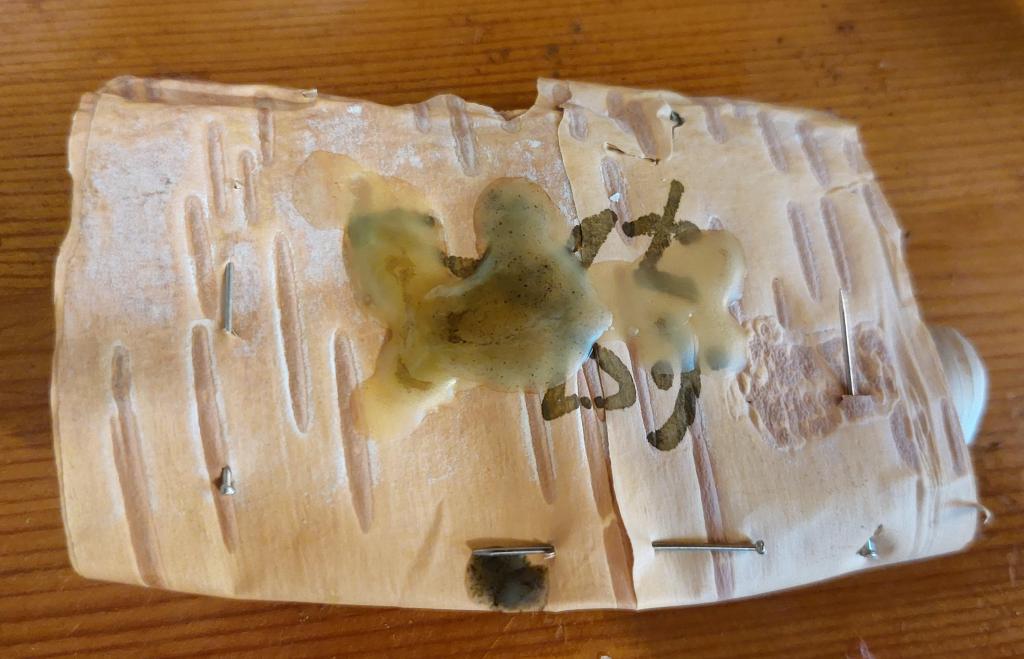
Pictured below is a working made from birch bark. The bark of the bark naturally peels and makes a flexible paper substitute. Traditionally, the most potent bark paper comes from lightning struck trees, but I have found it to be an effective tool regardless of lightning strike.
This particular working has a petition/request of the goddess Brigantia (Lancashire lays firmly in what was Brigante lands, hence why this working calls upon her).
A sigil has be drawn upon the front of the folded parcel and then sealed with wax from a yellow candle. The parcel is then fixed into place with pins. Each pin having had a specific chant said over them.
I hope that you have enjoyed this week’s blog and that it has offered some insight into this somewhat expansive area of Witchcraft! I intend to do more blogs on this subject as time goes by, where we can look into specific areas in much more detail.
Next week shall be a how too blog as part of the Grimoire Series and I will be teaching how to make a ‘Home Centre Candle’ for peace, balance and cleansing.
From the time, mists, and the distance between us, blessings from me to you.
List of References used:
The Wonderful Discovery Of Witches In The County Of Lancaster – Thomas Potts.
The British Book Of Charms And Spells- Graham King.
The Black Toad, West Country Witchcraft And Magic – Gemma Gary.
Cecil Williamson’s Book Of Witchcraft – Steve Patterson.
Traditional Witchcraft, A Cornish Book Of Ways – Gemma Gary.
The Lancashire Witches, A Chronicle Of Sorcery And Death On Pendle Hill –
Phillip C. Almond
The Witches, Salem, 1692 A History – Stacy Schiff.
The Museum Of Witchcraft And Magic
Orally shared Folk and Witch Ways collected by myself from other local Lancashire Witches.
 Diary of a Folk Witch