Not too far from me lies a secluded little nature spot called Viridor Wood, a long and pretty woodland where dog walkers roam, families have picnics, foragers pick wild edibles and sometimes, Witches explore. You see, deep within the wood lays the remains of a long and almost forgotten part of Lancashire history and folklore; a corpse road that runs (part way) along a brook by the name of Coffin Lane Brook. Today, this brook is largely hidden in dense barriers of nettles, cleavers and deadly water hemlock (appropriate really that Britain’s most deadly indigenous plant, one that can kill in just a few short hours, should grow so abundantly by the brook of an ancient corpse road).
Bryn Gates in Wigan, Lancashire, rests between the village of Abram and the town of Ashton-In-Makerfield. Prior to the mining industry of the eighteen and nineteen hundreds, Abram, like many other rural or semi rural areas, was left somewhat remote from surrounding towns and cities. This meant that in the event of a local person dying, it could be quite a long journey to the nearest church for burial. This led to the formation of what we now call Coffin lanes (sometimes also known as Coffin, Corpse or and Bier (burial) roads). These were straight, linear routes for funeral processions to the nearest parish church.
Usually, a body would be carefully loaded upon a horse and cart, if this was not possible, the dead would be carefully carried by pallbearers, potentially for many miles!
Along the Coffin roads, it was common for there to be occasional stop markers, such as a cross, stone slab or stile (to rest the coffin on), or Lych gates (if you were early for the service and had to wait outside the church). At these rest sites, mourners would be able to pause for a few moments, catch their breath, say prayers or recite psalms over the coffin that held a loved one, and perform regional funerary rites. These rites often vary from region to region, but could involve raising a glass to the dead with a favourite drink, or ‘turning the coffin’ – superstitious means of supposedly preventing the ghost of the deceased following the mourners home again after the service. This would involve rotating the coffin clockwise and having their feet point towards the church and not home.
Where Coffin lanes and Corpse Roads are becoming a rarity in the U.K, largely due to disuse, it is not uncommon to occasionally spot Lych gates outside of older churches, or see coffin stones/stiles along remote walkways.
And for those of us who know where to find our local Corpse roads, they often serve as a phenomenal liminal place of power. To the Folk Witch (both modern and historic), places such as Corpse roads served as equally as sources of power along with the more commonly used traditional Church or graveyard. However, it’s useful to note that one is less likely to be caught when performing a rite or working at a secluded coffin road then they are in a graveyard. A place where local Vicars, Priests, Vergers and Parish wardens often like to keep a wary eye out for young vandals and Witches. For the Folk Witch, where there is a will there is a way. If we cannot work in a graveyard to commune with the dead, we simply find a cross roads or coffin way…
Folk witches and Cunning folk have been harnessing the energies of liminal spaces such as water ways, church yards, coffin roads, woodlands, bridges and moors for time immemorial. As humans that constantly look to the outside of statistical and social norms, Witches seem to naturally gravitate to the places in nature that are neither hither nor thither. Neither a place of the living or the dead, the places at the forest edge, where water and land meet, or wild and desolate moorlands that are neither completely abandoned or fully inhabited. To the Witch, these are the in-between places where reality can bend and shift ever so slightly, in a way that it can reveal hidden truths, secrets and wisdom to the Witch that seeks them.
My Local Coffin Lane.
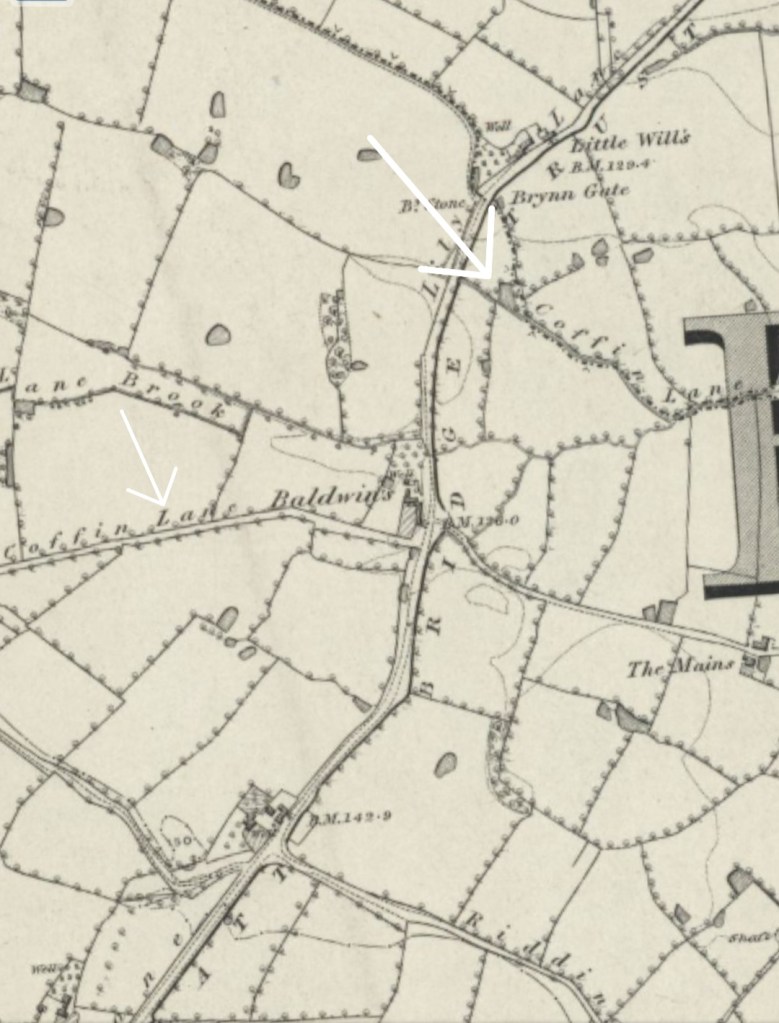
Despite historically being a busy industrial county full of mining pits and mills, Lancashire to this day still has some fairly rural areas. Just outside of the town of Wigan lies the small village of Abram. Although no longer remote, it used to be a roughly two hour walk to the parish church in Ashton-In-Makerfield. To compensate for this long journey, a Corpse road was trod from Abram, along a brook, across a main road (now Bolton road), up past what used to be Baldwin’s Farm, along a road called ‘Coffin Lane’ and on to Ashton, where a brief stop would be held at Bryn Cross (cross roads or coffin stones were common stops for funeral processions. Here, like at other liminal places, prayers and funeral customs would be played out) before they then made the last part of the journey to the funeral.
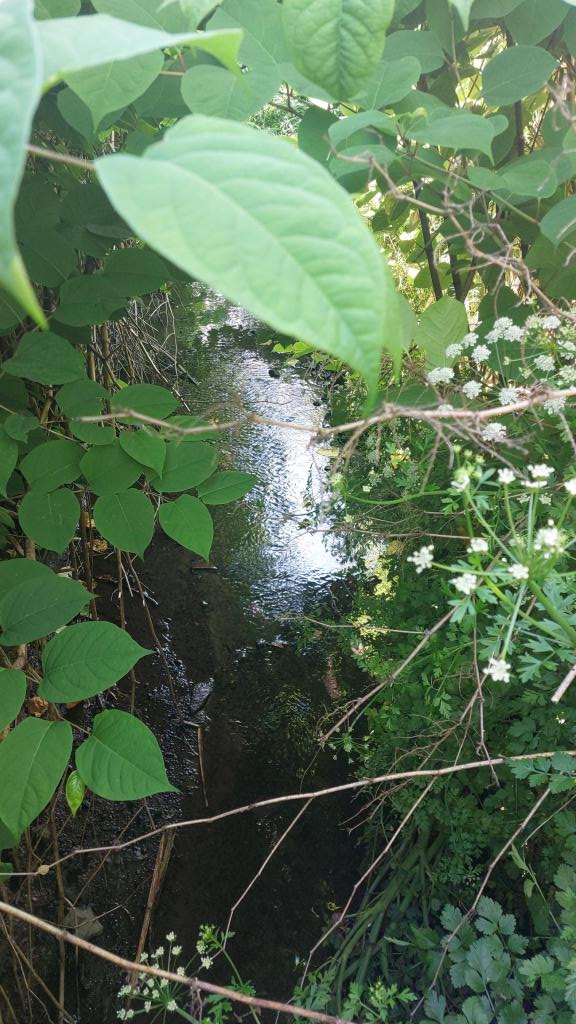
As well as stopping at Brynn Cross, it is also speculated that funeral processions would also stop in what used to be Coffin Wood, here there was rest, a quick drink and more prayers and psalms! Unfortunately, Coffin Wood no longer exists as it was destroyed in the creation of three slag heaps (known as The Three Sisters). However, it is thought that the modern woodland of Viridor covers some of what used to be Coffin wood. Viridor woods also houses what is left of the old Coffin Lane Brook which ran alongside what was the original Coffin Lane. Today, the brook resembles an overgrown jungle! Where nettles and cleavers abound, and deadly water hemlock grows in abundance.
However, when I visited this week, I was just about able to access some of the water ways! Despite having lived locally for six years, this was the first time I had the opportunity to explore this magical place. One thing I found really interesting was that despite never having visited this place before, somehow I seemed to intuitively know my way around. I entered what is now Viridor wood and it was though a sixth sense took over. I made my way through overgrown lanes and hedgerows. Past the abundant elder tress in flower, past the oaks and flowing maples until I came to a sudden stop. It was as though my inner SatNav pinged with a psychic “You have reached your destination”. As I stopped, I immediately looked to my left and saw it… a dark path that was shaded with a beautiful avenue of trees that arched over to form a canopy, sheltering the path from most sunlight. Despite being right there in front of me, this path seemed so different from the rest of the woods. Almost like a portal to another realm that was not really supposed to be there. And yet, there it was. It pulled at the Witch within me and beckoned me in, so naturally I obeyed. As soon as I stepped off the extremely sunny and hot main path, I felt as though I had entered some sacred hallowed place. A liminal realm that was neither here nor there. There was nothing frightening or foreboding about this lonely path, if anything, it felt inviting and welcoming. The more I trod the way, the more I felt my senses tingle! by the time I had reached the halfway point of the lane, I had come to a wider clearing that pulsed and sang with energy! I felt unseen eyes everywhere, watching me intently with interest. And yet I felt no fear, if anything, I felt both the spirits of the dead and that of the local land spirits (who seemed to be acting as wards for the area) beckon me on. Eventually I came to three things, Coffin Lane Brook, a bridge that crossed it, and a tiny narrow path that ran alongside. A path that clearly used to be wider, but was now gradually being reclaimed by nature from disuse. I was not in the least bit surprised to see a small footbridge. As previously discussed, Bridges and cross roads were commonplace along corpse roads, a superstitious means of preventing the dead from returning home. With some difficulty, I managed to walk some of the now heavily overgrown walk way, my feet are still sore from the aggressive nettles who attacked my feet (my own fault really, what sensible witch wears sandals while walking woodlands!). The whole time I felt observed by spirits wondering why someone living was walking their walkway, a walkway that few others now tread.
As someone who practices the Kenning (a term some families or Folk Witches use to describe a sort of mediumship-like skill- possibly of Scottish etymology from word ‘ken’, meaning to understand or know something, which if true, would make sense as I do have Scottish, as well as Irish ancestry) I am not unfamiliar with the presence of spirits and their various forms of communication. However, I was somewhat surprised to see a fully formed spirit ahead of me! In my both my personal experience and learned understanding from other mediums, it takes a lot of energy for a spirit to fully materialise, so it did surprise me to momentarily see a full apparition. The spirit said nothing, but instead raised his hand and pointed back the way I had came. He was not unfriendly or threatening, and out of respect, I agreed to his request and walked up the small walkway no further. I turned and walked back the way I had come and then turned right, back onto the wider path that had led me to the brook.
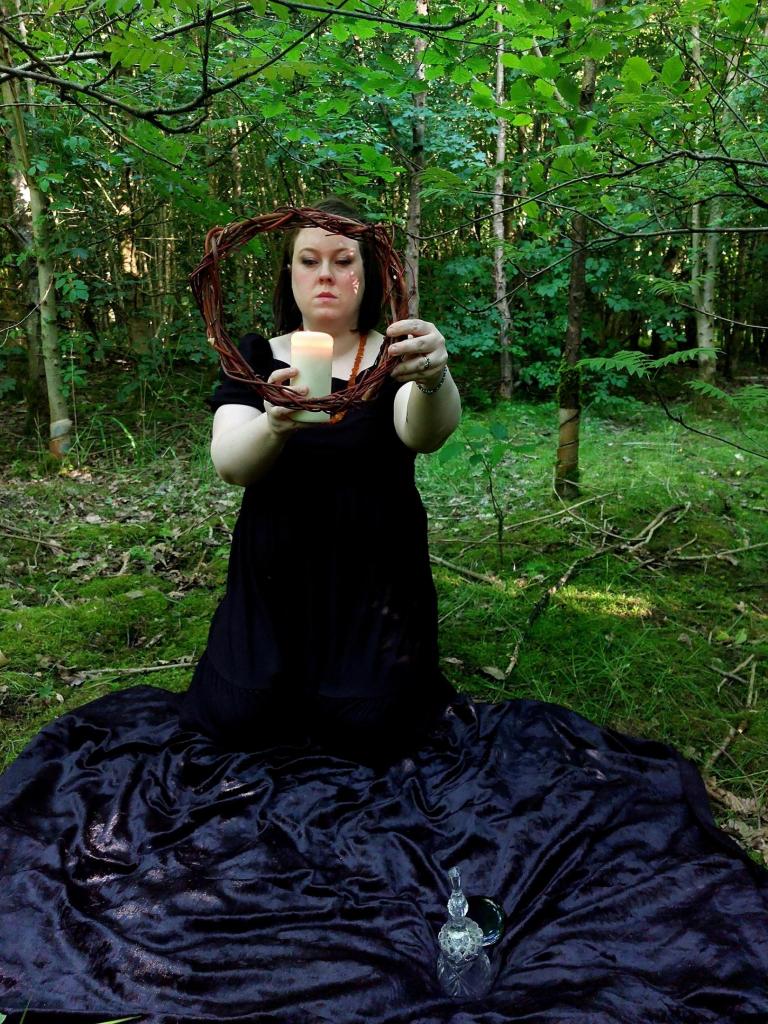
Once I had walked back up the main path and returned to the wider width of path that formed a clearing, I found myself a moss blanketed spot upon the ground and set up to perform some ‘Lych Watching’. For this, I strategically chose to sit between three rowan trees for protection. Rowan is a powerful protection ally and ideal to work with whenever doing any form of necromancy work.

The Lych Folk.
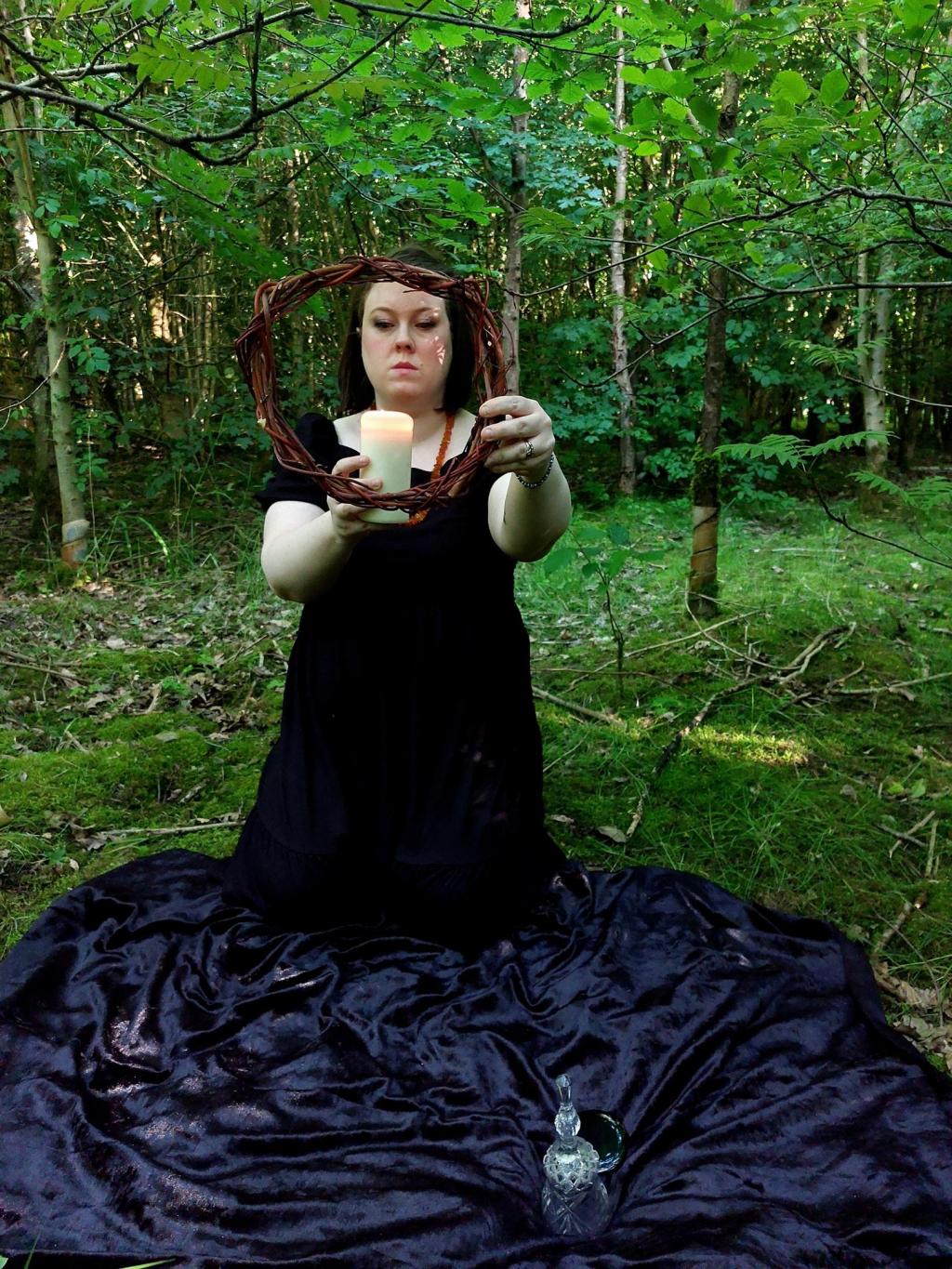
Lych folk or Lych watching are old terms used to describe the cunning folk or folk workers who would practice the necromantic art of sitting at certain liminal places to watch out for spirits who could be communed with, or at times, to watch and see if the shade of one who was destined to die over the next year, from within the community would pass by. These customs were often performed at certain ties of the year, such as Summer Solstice or All Hallows Eve. Such spots for this activity were cross roads, graveyards and their Lych gates, or corpse ways. Here the practitioner would simply sit and wait with a watchful eye. Sometimes with just the use of their eyes, and sometimes with tools such as hag stones or willow hoops to stare through (to aid in the sight), or occasionally with brass or glass mirrors that they would hold in front of them so that they could see any spirits that may walk or stand behind them.
If still commonly practiced, it certainly isn’t much spoken about. Which isn’t that surprising really as any form of necromancy is still often viewed as taboo, even within Witchcraft. This always surprises me, after all a Witch is a being of liminality. We follow the cycles of the year, we watch for signs and omens. We respect and commune with nature, our ancestors, and Fae. Yet mention openly seeking commune with the dead, and you often observe fellow practitioners physically recoil.
As you can tell, I am not one of these people. Where I do not go out of my way to pester the dead, and I absolutely deplore ‘ghost hunting’, I am not opposed to talking with any spirit that may cross my path… one can learn a lot from speaking with the dead. And I firmly believe forewarned is forearmed. After all, there is only one certainty in this life, and that is, one day, we will all pass into spirit ourselves. Therefore, it makes perfect sense to befriend the dead and decipher some of what may lay beyond the veil.
Working With Your Local Coffin or Corpse Road.
The Corpse Road served not only as a practical route to ensure peoples loved ones gained the correct and respectable funeral that they needed in order to be laid to rest, but also served for both a spiritual and psychological practice and relief.
In days where superstition and acts of small ritual and sympathetic magic ruled much of the waking hour of the working classes, Corpse roads and their associated customs and rites served as a way of alleviating some of the cultural anxieties around death. For example, there is the custom of ‘turning the coffin’. A method of stopping halfway along the funeral route to turn the coffin in a complete clockwise motion, resulting in the coffins feet facing the direction of the church. This was done to ensure the ghost or shade of the deceased was unable to look back towards home and find their way back after the funeral to cause a haunting. Other such techniques were employed to ensure that ghosts of the deceased were left at the site of burial, and this often included crossing bridges and bodies of water. As would have almost certainly been the case for my local Coffin Lane Brook. Many folk customs echo the belief that spirits cannot cross the bridges or bodies of water, because of this, coffin processions very often crossed or ran alongside small streams, brooks, bodies of water and even cross roads. All of the beforementioned would prohibit the dead from finding their way home and causing mischief. Belief around the power of liminal spaces are particularly strong here in Lancashire, with many folk tales relating how spectres either appear or disappear at places of liminality. Though some local lore does speculate that this usually prohibited boundary is lowered on All Hallows Eve, meaning that for a short time only, spectres and ghouls can cross such ‘tween spaces and wander the world freely.
For the Folk Witch, corpse roads can not only serve as a place of Lytch watching, but also a place of general liminal power. An ideal spot for scrying, divinations, magic and ritual. This is because such liminal spaces have the quality of resting between places and states. In the case of graveyards and corpse roads, they are places tween’ both the living and the dead. For places of water, it’s where land meets water. For crossroads, it’s where multiple directions, journeys and energies meet, all offering different routes. Within my own practice, a corpse road is a place ideal for necromancy and divination, and for anyone wanting to connect with such places, I would advise the following:
- Approach the area with care and respect. This is not your realm, and despite old Corpse roads being a place of the living and the dead, now that they are largely disused, they are solely the domain of spirits of the dead and local land spirits. If you sense the area and it’s spirits are not welcoming of you, respect that and leave. You can always try a spot further up the road or find another corpse road. Forcing an area to work with you and bend to or accommodate for your will can have very nasty outcomes. Such as curses, being ‘pixie led’, having accidents, and possibly even spirit attachments. If an area is happy for you to work there, it will give you a sign. If not, or you feel uncomfortable and unsafe, politely leave
- Always ensure you have a solid foundation in psychic and magical protection before doing any form of necromancy working. There are numerous cases of people having emotional breakdowns, being terrified to the point of hysteria, or again, attracting spirit attachments and possession from dabbling with things they have no practice or experience in. Psychic and magical protection fortifies you and provides an invisible armour that is hard to penetrate.
- Before doing any working, find a quiet place to sit and just connect with the area. Ask yourself how it feels? What plants and trees grow around you? Are there any plants or trees that can act as allies? Much like the Rowan did for me. What is the best route into the area, and the quickest and safest way out? Is the area quiet, or will you be disturbed by local dog walkers and ramblers? Learn your surrounding.
- Once you have got to grips with the area, sit quietly and close your eyes. Take a moment to call in any additional guides, allies, gods, wards or ancestors that you may work with so that they can offer guidance and protection. Once you have done this, extend your energy out and, either by speaking aloud or psychically, tell the spirits of that place that you have come to do no harm, that come with the upmost respect, and you would be honoured if they joined you today, but only if they intend to be friends and allies. ALWAYS be specific in what spirits you reach out too, otherwise anyone will rock up to join the party.
- Whenever doing a working at a corpse road, it is ideal to work within a circle of protection. Another liminal space, but one of your creation, where you can work safely with your protective allies assisting you, but all else remains on the outside of that circle. You can add to this circle by working directly near trees with protective qualities, such as bramble, rowan, ivy and oak.
- When leaving the circle, aim to take the route you entered by, this will further aid in preventing being spirit or pixie led. a well known phenomena which involves being left dazed and confused and unable to find ones way home. Victims will often find they are travelling in circles and are lost for hours, sometimes days.
- Leave no trace. Whenever working in liminal places of death, such as graveyards or corpse roads, it is advisable to bring everything you brought to the area home with you. This is not only respectful to the area, but also severs any physical links that you were ever there. The exception to this would be if you were making a pact or were leaving an appropriate and ideally, biodegradable offering.

Thank you very much for taking time to read this week’s blog, I hope you enjoyed it and that perhaps it has inspired you to research your own regions folklore and customs around corpse roads and funeral lore!
From the time, mists, and the distance between us, blessings from me to you.
 Diary of a Folk Witch