Hello everyone, and welcome to this week’s instalment of the tree and plant lore series, part of the premium content subscription service.
This week, I have a special treat for all of my wonderful Diary Of A Folk Witch community, and that is a guest speaker!
Mark Buxton-Kelly is a practicing animistic Witch, as well as being both a recognised Druid within the Order or Bards, Ovates and Druids, and has worked with the Anglesey Druid Order.
A prolific and recognisable speaker within the Pagan community on tree and plant lore, he is often invited to speak at moots, camps and various Pagan conventions. He also happens to be my husband, and the first in what I hope will be a long line of guest speakers on this platform! You can find more of his work over on Instagram, at Druid Of Manannan or over on his blog.
As we are approaching the Witch’s Sabbat of Samhain, Mark has chosen to share with us some of the modern witch and folklore around the autumnal favourite, the pumpkin.
So, grab yourself a warm cup of your favourite brew, sit down, put your feet up, and enjoy this week’s article.
As we approach Samhain, we are bombarded with images of pumpkins and fly agaric mushrooms as well as the plethora of skeletons and all things ghoulish. A mashed up cultural pot is thrown our way by the parent culture under the guise of Halloween.
As traditional style witches, and as neopagans, we often abide by the seasonal sabbats Wheel Of The Year, as popularised by Gerald Gardener’s Wicca and Ross Nichol’s Druidry, amongst others. Some of us use this wheel as a guideline, taken and combined, as it was from across several regional ‘Celtic’ peoples’ traditions. Many of us take a somewhat pick and mix approach to the way we celebrate or observe these seasonal festivals; very few of us practice in the exact manner of the Ancients to whom these festivals first belonged. This is mostly due to the drawing of the dual curtains of time and discontinued oral traditions. Perhaps it’s time to use the parent culture’s traditions to our advantage, just as countless generations of witches have before us.
In this guest blog in the Plant and Tree Lore topic, by Mark Buxton-Kelly, I have decided to take a look at the modern Jack O’ Lantern, the pumpkin. We will cover the humble turnip in passing too, as we look at briefly at the likely origins of the Jack O’ Lantern, but I wanted to focus more on the seasonally abundant pumpkin, it’s origins and some of the contemporary uses that they might be employed for by the cunning folk of today.
Brief Origins Of The Jack O’ Lantern.
First though let’s get a little bit of history on the Jack O’ Lantern out of the way. There’s some debate about just how old the tradition of carving vegetables is, but the Jack O’ Lantern, under that precise name is, mainly attributed to a conjugation of Irish myth and the mashing together of the ancient festival of Samhain, the birth of All Hallow’s Eve and the meeting of cultures on American soil.
There’s some folk that believe that the practice of carving gnarly faces into vegetables and even back lighting them with rush lights or candles dates right back in to the Bronze, or, Iron Age of the Celtic lands. It’s certainly not an uncommon practice in cultures around the world.
Certainly, it is longstanding tradition that Samhain is associated with the end of summer, a period of death and the visitation of ghouls and spirits as the nights got longer and the cold weather claimed the old and vulnerable more easily than summer’s warmth did. However, the idea of the veil thinning can only be traced back to the Victorian Spiritualists who, taking a lens forged of Christian mythos, imposed the idea of there being separate realms (heavens and hells) that simply wasn’t around in the ‘Celtic’ lands; where the Otherworld could simply be walked in to if one went far enough, or knew where the path lay…. and where the dead weren’t relegated to returning once a year.
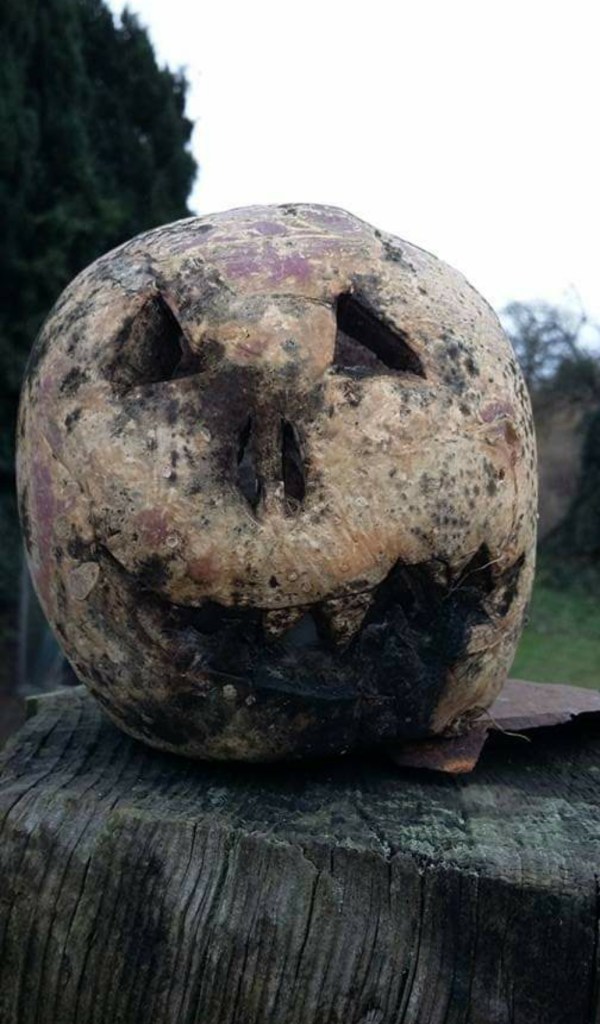
All that regardless, the Irish lore often attributed to the origins of the Jack O’ Lantern is that of Stingy Jack; a rogue who bargained too well with Satan and in doing so prevented himself from entering either heaven or hell. Alternatively it is attributed to people making mocks of the Will O The Wisp so they were not misled themselves by meandering winter spirits. Historically, the vegetables chosen to carve faces in to were the turnip, the mangelwurzel and, relatively shortly before the knife met the pumpkin, the potato.
It is likely, from records, that the Jack O’ Lantern, or Hop Tu Naa in Manx tradition, as a named tradition, is mainly of 19th Century origin and, certainly, spread prolifically from the coming together of cultures in the mixing pot that is America; fuelled particularly by Irish immigrants.
The States was the location where the humble pumpkin met with these imported traditions…. and so, let’s move on to the origins of the pumpkin.
Meet The Pumpkin…
Curcubita pepo, as the pumpkin is so named to the botanist, is a native plant to the Americas. It’s considered one of the oldest cultivated crop plants with seeds and other archaeological evidence for it’s cultivation being dated to around 9000 years old in sites of ancient human habitation in Mexico.
Pumpkins are usually considered one of the winter squash varieties, but the name we use today suggests that the large pumpkin we know today was a key form of the fruit (technically a berry) to indigenous populations. Pumpkin as a word comes to us through the Greek ‘pepon’ (meaning melon), through Latinisation to ‘peponem’, then French to ‘pompon’ and finally anglicised to pumpkin.
It is possible, indeed probable, that the Greek pepon was informed by an indigenous word, ‘pôhpukun‘ which means ‘to grow forth round.’
This word comes from the Wampanoag people who met the English Pilgrim Colonists at Plymouth County, and famously helped them with gifts of squash and corn when the Pilgrims were starving.
Witchery And The Pumpkin.
So what has that to do with Traditional Witchcraft today?
As with anything in witchery, it has nothing to do with you unless you adopt it… so let’s start with a few edible facts:
- All parts of the pumpkin plant are edible, with the relatively high protein leaves and stems being used as vegetables in salad and cooking, the fruit being used for curries, stews, pies (both savoury and sweet) coffee spices, smoothies and pasta sauces amongst other things.
- The seeds can be roasted, toasted, dried and ground or used to make oil. Historically they have been used as a traditional vermifuge – that is an expeller of parasites, namely intestinal worms.
- The plant is rich in nutrients like potassium and can be a great addition to the diet to help combat modern world fatigue.
- It makes a sweet and simple plant ‘jerky’ when dehydrated in thicker slices.
Now let’s look at a few practical witchcraft uses for the pumpkin.
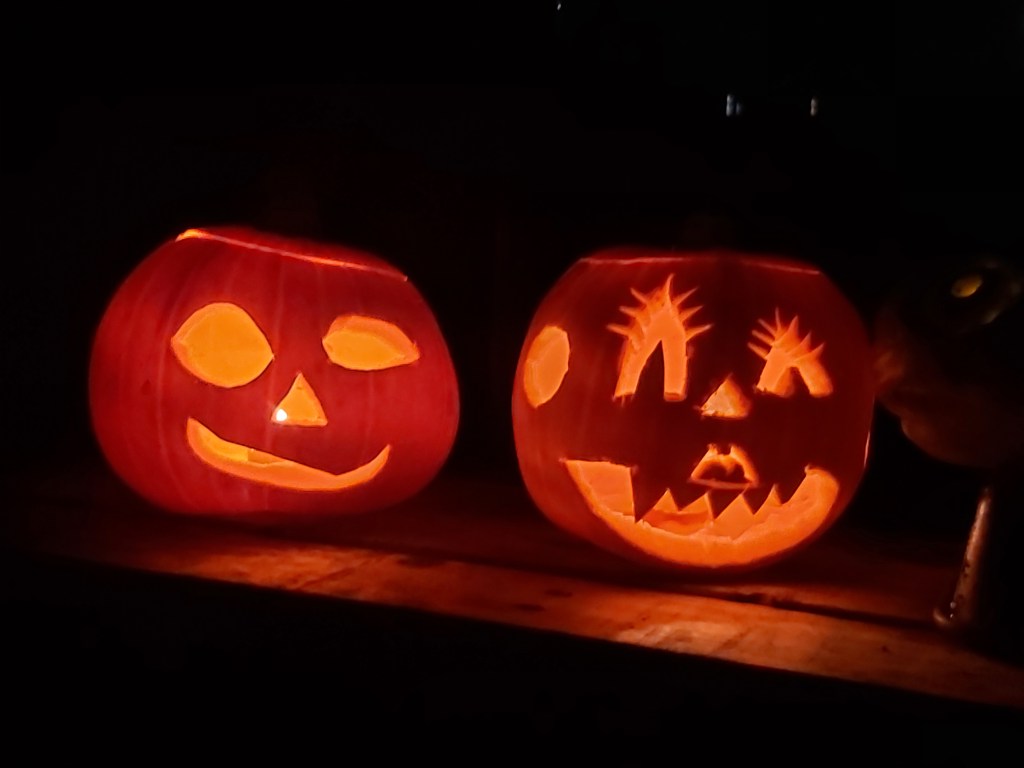
- In previous articles, this blog has looked at ‘Spirit Houses’ and the Jack O’ Lantern can be treated as such – some will even use them as a vehicle for spirit guests at Dumb Suppers (a tradition being upheld by some modern witches and pagans in which a silent meal is prepared and consumed with a place or more set and served with food to honour the dead). In this way the carved pumpkin can serve as eyes and ears for those in visitation and even be useful for divining, in a soft trance like state, who it is that has stopped by to share a meal.
- In the same vein of thinking, a pumpkin can be used at the gate post or window to impose/suggest a protective presence and so encourage the more nefarious spirits on their way. Or, to be used as a temporary poppet, or to house a thought form designed to protect/welcome/dissuade would be guests.
- Any baked goods made with the pumpkin make tasty, if unorthodox, Tricks (add hot chilli and a cackle) or Treats.
- Samhain is often seen as a time to lay down offerings of thanks, bribery or appeasement to the Fey folk, or other Spirits of the Land or hearth, and so a slice of pumpkin pie, or a dish of pumpkin spiced and sweetened milk, or even a handful of toasted pumpkin seeds left out for the Good People, will likely serve you well. Obviously, one must use one’s own judgement as to what would be appropriate for the beings in one’s area….. although I reckon a sweet or savoury pumpkin dish will always be more appreciated than a bit of turnip, potato or mangelwurzel.
- Finally …….. Black Salt and Servitor Ink
Black Salt And Servitor Ink.
If one wields one’s craft while carving out a pumpkin, as in does so mindfully and in ritual space (whatever that means for you) it is possible to treat the entire pumpkin as a ritual tool. Carve out the face/sigil etc and cook the removed flesh up for your preferred use and then, in this instance, place the seeds on a baking tray and salt liberally.
Place the seeds in to a low – mid oven and cook until charred. this is going to be the basis for your Black Salt and Servitor Ink, which, in this instance, will only have one step between them as far a physical preparation goes.
When the seeds are thoroughly charred they will powder up swiftly in a pestle and mortar. Grind them as fine as you can, until you are left with a fine soot like dust. If needed pass through a sieve to remove any stubborn or under burnt pieces.
For the Black Salt you will now add in the same volume of sea or rock salt to the sooty powder you have, grind it fine again and then you have it for all your uses. Whether you’ve made the pumpkin in to a protective form, an inviting form, or a divination form will, obviously influence your future use of the salt.
For the Servitor Ink, take the sooty powder, or alternatively the finished Black Salt, and add in just enough fat to make it in to a thin, slick paste. Consider what oil or fat you should use – an olive oil, or a tallow will work better than a margarine or butter, but if your desire is to make a Servitor to engage positively with your local Faerie folk then butter might be a better choice.
What makes this Servitor Ink you ask? Well, it’s all in the using.
Many Servitors are given a home that resembles a poppet or fetish, while others are bound in to a glass jar, and so on. Your black paste can be used to paint sigils on said representation, or to write instructions on paper/parchment/birch bark or smeared in to etching on a candle or clay tablet.
Being made of oil and char it makes a good choice to help clear and end a Servitor’s existence using fire when it’s purpose is done.
I hope that this blog, although perhaps slightly different, has inspired you to pick up a pumpkin and enjoy it’s presence over the Samhain period.
Thank You.
I think I speak on behalf of all of us when I offer Mark a huge thank you for his time and shared knowledge this week! Please feel free to head on over to his pages to check out and support his work.
From the time, mists, and distance between us, blessings from me to you.
 Diary of a Folk Witch
2 responses to “Tree And Plant Lore Series: The Pumpkin In Modern Folk Magic.”
Hello I’m new here. Thank you this was fascinating. Can you explain what you might use the servitor ink for in a bit more detail 🙏 and how you would do this. X
LikeLike
Hi there Penny! Lovely to hear from you and thanks for your kind feedback. As this is a guest blog, I can only offer you my perspective on servitors and the use of special or specific inks. Views which may be different from our guest writer. What I can do however, is to ask him to do a post on the private FB group detailing his take and the use of servitor ink for you if you would like? Are you a member of the group? If not, please email me at Diaryofafolkwitch@gmail.com and we can get you sorted out. Best wishes, Zanna.
LikeLike