
The pendulum is a form of divination that comes directly from the practice of dowsing. Dowsing being an old way of using tools such as pendulums or dowsing rods to locate water sources, lay lines, etc.
As well as this, the pendulum has been incorporated by many folk workers and witches over the years to scry for simple, yet effective yes, no, or maybe, answers.
Sometimes the folk worker or witch would be lucky enough to have an actual crafted pendulum, such as a well balanced piece of cast metal on a cord.
At other times however, it was not uncommon for folk witches to use their own wedding bands tied to a shoe lace, or some other cord in order to have a make shift pendulum for the seeking of answers to life’s big questions. Such as, ‘Will I be married within the year?’ ‘Am I carrying a boy or a girl?’ It’s for this reason that this form of divination, historically at least, is often more associated with wise women’s practice more than it is with male cunning folk practice. This is not exclusive however, as there are accounts of male cunning folk using pendulums to try find lost objects
Owing to the fact that the pendulum could be an inexpensive tool to create, either with a wedding band or even a hag stone on a string, it is one that has been used for generations.
Ironically perhaps, it was not through my family’s folk ways that I first discovered the pendulum as a divination tool, but at a girls sleepover that I attended as a teenager. One girl wanted to find out if such and such a boy shared mutual feelings for her (teens eh?), so another girl suggested taking off her necklace and using the chain and pendant to see which way it would swing; clockwise for yes, anti-clockwise for no. The pendant swung anti-clockwise for no, the girl’s crush did not reciprocate her feelings. However, hormones and stubbornness led this girl to disbelieve the makeshift pendulum’s answer and so, confront the boy the following Monday to confess her feelings. My friend was left somewhat hurt and red faced when her crush laughed (in a way that only mean-spirited teens can) and gleefully informed her that she wasn’t his type. Although sad, and painful to watch, it did reinforce to my friends and I, that perhaps there was something in this teenage magical exploration of pendulums after all?
I confided in my mother about this experience and she told me all about pendulums; how they could be made from odds and ends (such as wedding bands or pendants on a cord, string or chain) or bought from occult and esoteric stores, and how they could be used.
I not long after this bought my first pendulum, a polished rose quartz point on a silver chain from a small seaside shop in Dorset, and have been an avid and dedicated user since!
In fact, my first ever talk at a Pagan event was about the use of pendulums. And here I am, about twelve years later, moving on from talks and workshops, to blogs on my own website!
But how do you use a pendulum, and how can you be sure that you can trust the answers given? Here are eight tips in starting or refining your personal practice with the pendulum
1) When Buying A Pendulum.
When looking for a pendulum to purchase, there are some key features to look out for, all of which help it’s use to be far more accurate and perceptive.
- Material: materially speaking, you have a lot of choice, crystal, metal, stone, marble, wood etc. All of which work fine for official pendulums, providing you personally gel with the piece. I find that choosing the right pendulum is a lot like choosing the right pair of shoes, or even the right crystal. It has to fit, it has to be comfortable, and it has to feel right for you. I have had traditional metal pendulums before and they just don’t work as well for me. Stone works ok, wood – well, that depends on which tree the wood comes from…
And crystal, well, these work best for me, and are the most reliable, but only in clear quartz, rose quartz, onyx and amethyst. One further addition to this personal list could be amber. However, where amber is used like a crystal, it should be noted that it is actually an ancient tree resin, and unlike true crystals, has no piezoelectric effect (the quality that makes a crystal).
I use amber A LOT in my personal magical system, my runes are made from amber, I wear amber for protection, my children wear amber, and so on. So it makes sense that an amber pendulum would also work for me. When it comes to crystals and amber, I find it better if the stone or material is raw and unpolished. The more natural and unrefined the piece, the more of it’s original energy comes through and can be harnessed in divination, workings etc
Ultimately, a pendulum is like any other occult tool. You need to be able to resonate with it both personally and energetically. So where the above crystals or naturally formed amber may really work well for me, you may prefer something else entirely! So explore the field and play about a bit. Perhaps even try multiple pendulums to see how different materials work (or don’t work) for you. - Balance is key: When it comes to a good pendulum, you want a piece that has a good balance. That doesn’t mean that it has to have come from a cast mould, or has a perfectly smooth and lasered form (as many crystal pendulums will), but it should have a good weight – not too heavy and not too light.
It should have a point at the base of the pendulum, and should be strung to a cord, string or chain from either the centre of the piece or top of the pendulum.
In extension to this, the cord or chain that the pendulum hangs from is also vitally important and should compliment the weight and balance of the pendulum. Metal chains are ideal, but some cheaper pendulums often hang on subpar overly loopy chains where the links vary in size or are too big, too light etc. If you find a pendulum you like, but the chain or cord is all wrong, don’t despair. Why not see if you can swap it out for a new one? I have done this several times over the years, with either faulty chains or ones that have worn out over time, and it works very well. If you are going to change out the chain, I suggest a good quality gold or sterling silver chain from a local jewellers. - Don’t go too long: When it comes the overall balance of the pendulum and cord or chain being used, it is also advisable to take into account the length. While it is possible to use a longer length and have any excess wrapped around your hand, this is not ideal and can interrupt flow of energy and movement. At the same time, having a length that is too short is not going to work very well either as it will impact movement and whether or not it will even work at all. There is no one-size-fits-all length for a pendulum cord, but ideally you want something between seven and nine inches. This can vary depending on personal preference and practice, but do remember that too long or too short will impact the balance and accuracy of a reading.
2) Use Your Dominant Hand.
When conducting a pendulum reading it is always advisable to use your dominant hand. This is because it is not only the hand that you are naturally most practiced with, and the one you probably use the most within both witchcraft and day to day activities, but most importantly, it is the hand that you have the most control over. Hand control is very important with pendulum dowsing, you do not want to do this practice if you’re anxious, giddy from caffeine, or unsteady because you’re attempting to use your less dominant hand. An unsteady palm can impact answers a great deal and can skew an answer completely. So, where possible, use your dominant hand.
3) Eyes Closed Please.
One of the things that I have noticed over my many years of practice, in both my own and in other peoples, use of the pendulum, is that it makes a great deal of difference as to whether a wielders eyes are open or close
Why? Well, it’s quite simple really. When our eyes are open we are slightly more likely to (consciously or unconsciously) try and skew the pendulum to give us an answer we really want. And this is easily done, surprisingly with no grand hand gestures at all, in fact, the movements are so minute that unless you know what you’re looking for, it can be missed entirely.
One way around this, I have found, is to ask the pendulum the question you want an answer too with your eyes closed! And then keep them closed until you sense (not ‘feel’, but sense) that the pendulum is giving you an answer. This can take up to a minute, but does give more accurate answers as you’re less likely to subconsciously influence the pendulums answer. The simple act of closing our eyes to use a pendulum doesn’t impact our balance as such, but does force a part of our expectant consciousness to pause and wait in the dark while an answer comes through, it’s also much more tricky to intentionally skew an answer in a discreet manner if our eyes are closed as we are missing a huge cue and guidance with the subtle slight of hand that could falsify an answer, the use of our eyes.
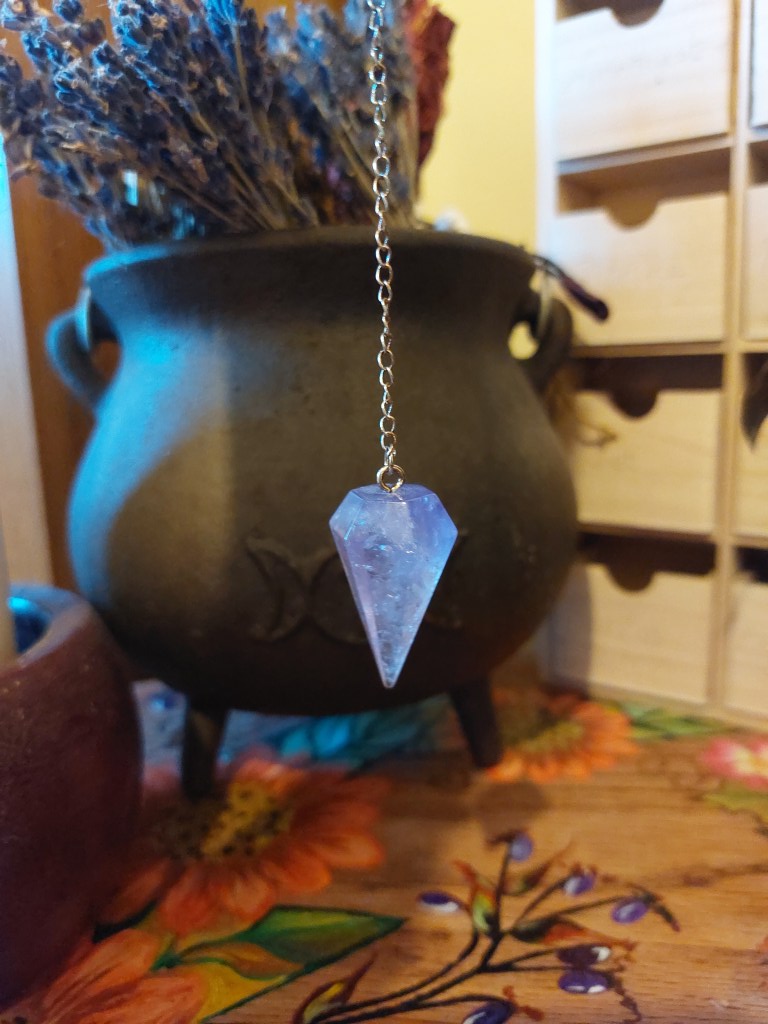
One of my personal pendulums, made from amethyst. Original photography by ZBK 2022
4) Consistent Direction Is Everything.
When considering the direction of the pendulums swing for the giving of answers, it is not uncommon to find practitioners use a system of:
- Clockwise for yes.
- Anticlockwise for no.
- Stationary or generic to and fro and for unknown answer.
Although this is a common system for divining answer with a pendulum, it doesn’t have to be. You can find alternative ways of seeking confirmation to answers. Such as anticlockwise for yes instead of no, or abandoning all use of clockwise vs anticlockwise and instead using a divining board (see picture below) where direction matters less, and instead focus is placed upon where the pendulum is drawn to on the board.
Whatever system you use within your personal practice, seek to maintain consistency, and stick to it. That way the spirits you work with to channel the answers you’re seeking will always know what movement language to speak when communing through the pendulum to you.
5) Do I Need A Pendulum Board?
In short, no you don’t. They are an interesting tool, and can jazz up your practice a bit, but I, personally, find them a little superfluous and I prefer the age-old method of just sitting still and holding the pendulum before me to ask questions. Either just hovering in the air, over a map, someone’s photograph (when doing a distance reading for example) etc.
When it comes down to pendulum boards, it once again comes down to personal preference. If you like the idea of using one, or simply find that it works best for you, go for it!

Image taken from Tools Of Divination, Etsy.
6) Testing Questions And Calibration.
Now you have found the right pendulum, you have made sure it is a well-balanced piece, that it works for you, that you have your consistent directions for answers sorted, it’s time to work with the dowsing tool.
As this form of dowsing can easily be impacted by slight of hand and environmental factors such as a breeze, someone opening or closing a door or window etc, it’s always ideal to test the pendulum prior to asking any of the really juicy questions.
This not only helps you to ascertain if your pendulum is actually working, but that whatever spirits or gods you’re working with are being, or at least as trying to be genuine, when they offer you answers. Because let’s be honest, not every spirit, ancestor or deity is going to have your best interest at heart. That is just a harsh truth of working with the spiritual realms. For every guide and positive spirit or deity, there are always some tricksters nearby who will try to interfere if your psychic protection is not well established or you’re attempting divination in a very Gung Ho or cavalier manner, without pausing to consider who it is you’re asking or inviting in to give you guidance?
In order to test the pendulum, I will usually ask between three and five questions that I already know the answer to, answers that I know my ancestors, guides or specific deities that I work with and trust will also likely know the answers too.
Questions such as, “Am I fifty-seven years old?” (I’m not).
“Do I live in Lancashire?” (Yes, I do).
“Was I born in Ireland?” (Trick question, I was not, but am of Irish descent and applying for citizenship).
Trick questions are ideal ones to throw into the mix where possible and will usually highlight if the pendulum is being accurate.
If you find the pendulum is not giving you correct answers to your testing questions, it’s not the end of the world. Nor does it mean your pendulum is energetically broken, you’re not good at the practice, or that something untrustworthy is trying to influence your tool.
It could be as simple as the moons phase, your mental attitude of the day (for example, if you’re overly tired and low on energy), If the tool has been overused and is in need of a cleanse etc.
If you find the pendulum is not playing ball, put it aside and cleanse it in a way you would any of your other occult or esoteric tools, and try again another day. Or, if you’re in desperate need of a pendulums guidance, try and use a different pendulum. Just be aware that if you’re tired, unwell, etc, no amount of tool swapping is likely going to improve that day’s practice and answers offered. Go and rest instead.
7) Who Are You Talking To?
This is such an important, and so often overlooked area of the pendulum practice that it does really alarm me. I often see other practitioners use a pendulum and not for one moment consider who it is that is giving them the answers to their asked questions. It just seems taken for granted that the answers mystically appear, or that the pendulum itself is answering them. Yet, this is not the case, it is just a tool in your hand, and even to animists such as myself, who believe in the soul or energy held within everything within this world, from humans to plants, animals and even rocks, ultimately… the tool is just a tool. It’s energy and essence may be working with you to channel answers to life’s big questions, but like any other divination tool, the answers come from the realm of spirit or some other unknown and unseen force in the universe.
Therefore, when you hold the pendulum, ask yourself, “Who do I want to work with today?”
“Who do I trust to give me honest answers to the best of their ability?”
For some, this could be some form of creator-like energy, such as ‘God’. For others it might be some other deity. Some people even call upon trusted spirit guides or ancestors.
What matters is that you set that intention of who you want to call upon very clearly at the very start of your reading. This could be a small mental petition to whoever you’re asking to communicate through the pendulum to you, or it could be a specific prayer, verse or call you have written and use each and every time you start a pendulum reading (this would certainly build power and define boundaries for psychic protection if you used it each and every time you did a pendulum reading).
Just remember though, it’s rare that any spirit or god is infallible, even the gods make mistakes, and ancestors, even well-meaning ones can misinterpret signs and omens. Therefore, even when pendulum does give you answers, be careful how you act upon them. Bide your time and even possibly seek secondary confirmations from other divining sources, such as the tarot or runes. Then if you have several affirmatives from three or more sources, the chances are, the answers are accurate.
8) Don’t Overuse Your Tool.
Pendulums, like any other divination tool can experience a psychic ‘burn out’, a phenomenon that occurs when a practitioner not only overuses the tool but does not regularly cleanse the item or allow it to rest. This psychic burn out is often discussed within Tarot circles, but is also applicable to many other divining tools, especially anything crystal based, such as many of todays marketed pendulums.
It’s important to understand that our tools are not just an extension of ourselves but are also uniquely themselves and individuals at the same time. Just as we need time to rest, recuperate, recover etc, so do our tools within witchery. Part of this goes back to more animistic principles within folk magick, the understanding that even inanimate objects, especially ones formed in nature such as rocks, trees, shells etc, all have their own variations of consciousness and existence. Therefore, they can burnout too. Burn out doesn’t mean the tool is hereby forever useless. On the contrary, it can often be cleansed, given a rest time, and then be fit for use again. However, it’s also not unheard of for a tool to refuse to work for the one who burnt it out initially. One example of this was when I accidentally burnt out a pendulum while as a college student. I cleansed it several times, gave it time to rest etc. But no matter what I did (even earthing it in the ground) it just would not give me a reliable or accurate reading. I was going to put the pendulum to rest permanently in the found when my house mate asked if she could have the pendulum. “Knock yourself out,” I said. Much to my annoyance and red face, the pendulum worked fine for her. The pendulum had found a new owner and simultaneously taught me a valuable lesson. Treat your tools with love and respect. You do not ‘own’ them, it is a mutual relationship of trust and respect.
I hope that you have enjoyed this weeks blog, I wish you all a very happy winter solstice, a merry Christmas and a happy new year!
From the time, mists, and distance between us, blessings from me to you. Happy birthday, happy birthday
 Diary of a Folk Witch