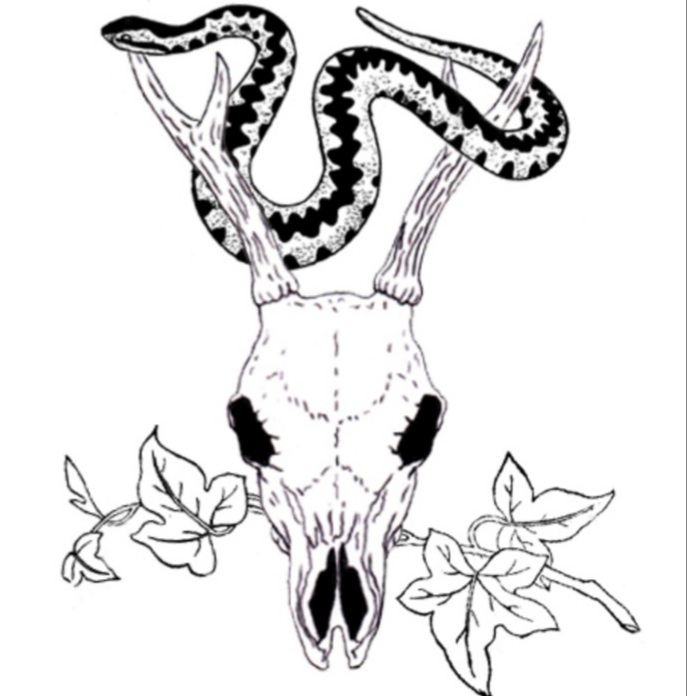

Ivy, or Hedera helix, is commonly found throughout the British and Celtic Isles, and many other Ivy species grown around the world too.
You can stare at the Ivy and it seems like she never moves, but be careful…
take your eyes off her and you shall soon find that she has stealthily scaled your trees, fences, and even your home! There is something almost unsettling when encountering an old home that is covered in English Ivy. Has the home been abandoned? Is it haunted? Is someone watching me from Ivy shadowed windows that loom high above?
Ivy can be off putting to many people, with some gardeners and caretakers seeing it as a pest to be controlled or eradicated – especially as Ivy can grow in to brick work, as well as making a wonderful home for birds, bugs and spiders!
However, there is another side to the Hedera helix, she is not just one of destruction, she is also a fierce protector, shielding, and able to bind both known and unseen enemies! I often wonder if it is the almost paradoxical qualities of the Ivy that contributes to the fact that she is often relegated to the mere side lines for many Witches?
In many ways, Ivy represents the shadow self of humanity. We are both light and dark. Able to climb the greatest of heights and achieve our dreams, but we are also dark, and at times, destructive; able to choke and obstruct.
For many Neo-Pagan Witches, this sort of duality and avoidance of pure ‘love and light’ can be problematic. Which I find a shame, as the shadow self is just as vital and worthy of exploration as our supposed ‘light self’ is. Also, when one avoids the liminal spaces within witchcraft, or the obvious shades of grey within nature, we do ourselves a disservice. You cannot appreciate the day without living through the night, and you cannot experience the entirety of natural earth magick and folk ways if you just strive for a very middle of the road, and safe practice.
Ivy teaches us to value the liminal spaces within both our psyche, and within nature and magick. She shows us that despite growing in the warmth of the sun, and ever climbing towards the light, she can cast shadows and darkness too. Within the sanctuary of her vines, life creeps and crawls, Ivy nurtures and sustains this, and will grip to walls and trees all the more tighter in order to grow and sustain the life within her darkness. She will forcefully grow through the hardest of concrete and stone, breaking apart anything that seeks to prohibit or block her.
If we were to view plants as archetypes, to me, Ivy would be the dark goddess, an almost Cerridwen like figure. The representation of the dark and the light combined and able to harness both great power and destroy if necessary. Ivy can also represent the human drive to succeed, to ‘climb the ladder’ no matter what. Just as humans can be, Ivy can be quite pervasive in her will to dominate and expand. Utilising all around her to have her way.
Associations With Death.
Ivy is often associated with both death and it’s relevant folklore, largely because Ivy is a plant that will expand and take over when left to do it’s own thing. This is especially true in older and more untended cemeteries and graveyards, or ‘dead cemeteries’ as they are sometimes known. Places where most, or all of the graves are now so old that they are completely untended, as there are no loved ones left to fulfil the task. I remember walking around the somewhat infamous Highgate Cemetery In North London when I was a teenager and being completely in love with it’s desolate beauty. In it’s hay day, Highgate cemetery had been an extravagant Victorian cemetery in the heart of the very upper classed area of North London. A necropolis of ornate mausoleums, tombs, crypts and graves.
Today, although looked after by the ‘Friends of Highgate Cemetery’, Highgate has largely become one of the ‘dead cemeteries’ I mentioned earlier. Home to ghost walks and urban myths such as the Highgate vampire and Spring heeled Jack. Many of the tombstones in and around the necropolis are crumbling away, with Ivy herself climbing the stone and draping down like an elegant reminder of time passing. It is this sort of scene that largely contributes towards Ivy’s association with death and the passing of time.

However, alongside Ivy’s habit of taking over unkempt graveyards, her plant lore also echoes other whispers of death. In some cultures, it is seen as unlucky to gift a plant of Ivy, believing it shall bring death to the recipient. Here in Lancashire, picking three Ivy leaves on a midnight in winter and then either posting them through the letterbox, or under the doormat of an enemy is said to bring them death or unemployment (Interesting as this could be viewed as a financial death). Throughout various regions of the British Isles, it was seen as extremely unlucky to bring Ivy into the home (presumably due to it’s superstition around death?). According to some folklore, a grave where Ivy would not grow, but would grow in all other places around the grave, was said to hold the remains of a person who was now a restless soul, unable to find peace or cross over. Seven pieces of Ivy taken from the grave of a loved one, and then hung upon the mantle above the fire was said to invite the spirit to speak with you through the scrying of the flames.

Ivy As A Protector.
Interestingly enough, where it is often thought of as unlucky to bring Ivy in to the home, it is almost always believed to have a supernatural protective like quality when growing on the outside walls of the home. Here is that interesting paradoxical nature once again… both omen of death and fierce protector.
Homes that have Ivy climbing, or better yet, almost covering external walls entirely, are said to be protected not just from mundane everyday acts of voyeurism (due to Ivy casting shadows against window panes), but also from the evil eye, ghosts, Witches and the Devil himself! Ivy forms strong vines that grip, cling, weave and bind. It’s believed that anyone or anything untoward that tries to break the boundary of Ivy will be snared and bound (energetically). If Ivy on the house ever began to wither or fade it was thought to be a sign of great misfortune or an imminent calamity. Ivy forcefully removed from a home was said to leave the home ‘naked’ and open to all manner of trickery, witchery and misfortune.
Psychically speaking, Ivy is often used as a plant ally within psychic protection workings, or to form an almost thought form like guardian that is imbued with the plant energy in order to protect and ward. Magically speaking, Ivy has long been used within folk ways and magic to create protection spells. One such working is to collect two twigs of rowan and then make ones way to a local cemetery (depending on which version of the working used, one would go at dawn, dusk or midnight- all liminal times of the day). Once at the cemetery, the Witch would walk around the graveyard three times and then find a grave where they could pick thirteen fresh and vibrant Ivy leaves. The Witch would then turn and walk all the way home, ensuring that they did not look over their shoulder, or directly behind them. Otherwise the working would be undone. There are several versions of this working floating around the internet, books and regional folklore, so if you know an alternative version, please feel free to use it.
When doing a workshop at PaganCon a few years back, I was teaching a rather large group how to create this charm, when one member of the group asked why you were not meant to look over your shoulder on your way home from the graveyard?
“It’s a form of initiation”. I replied. When working with spirits of the land and places of power, especially graveyards, some workings may call for you to have complete surrender and trust in the process. To look back behind you shows a lack of trust. You’re demonstrating fear when you should be brazen and bold!
Not only this, some Witches, especially it seems in Lancashire and Yorkshire, believe that when one works with a graveyard, it can attract both helpers and hinderers…
Where the guardians of a place may protect you while on the premises, it isn’t impossible for something (in spirit) to try to follow you home. This sort of malefic spirit preys on fear and mistrust. So, to turn back and look behind you is almost an open invitation for a spirit to attempt to attack or latch on to you. Where, on the other hand, showing fearlessness and confidence, walking home and not feeling as though you have to peer behind you almost certainly boosts your natural protection.
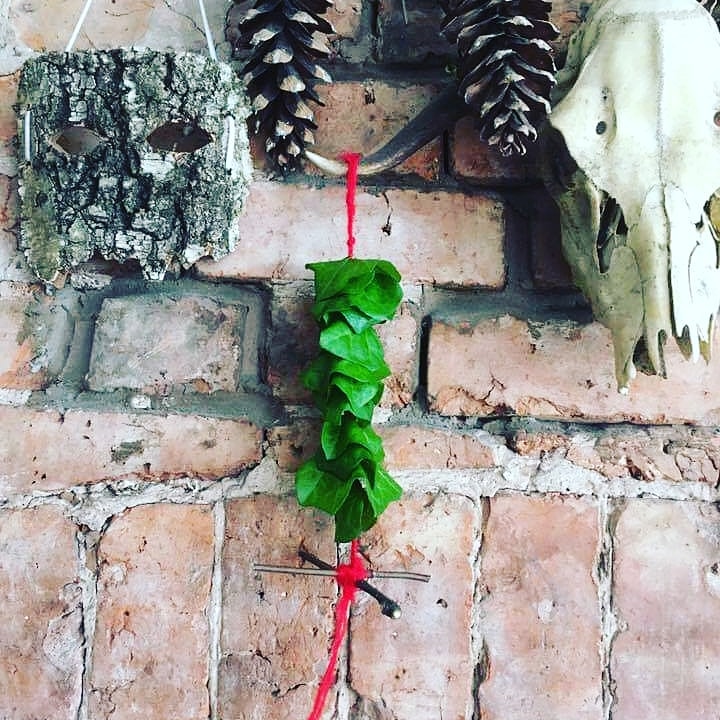
Once home, the practitioner would then sit by a fireside or candle to create the protection charm. To do this, they would take red thread and form a rowan cross. Then, from the rowan cross, another length of red cord would be hung, and from that cord, each of the thirteen Ivy leaves would be threaded.
Once formulated, the charm would then be hung either by the fireplace or the front door, and was said to protect the Witch from predatory spirits.
It’s interesting to note that where most customs in plant lore show that many people are wary of bringing Ivy in to the home, this does not seem to apply to the Witch. Perhaps because they, like the Ivy, are liminal beings. Fully capable of embracing the light and the dark and of the paradoxes in between. The Witch and the Ivy are old friends.
Ivy For Binding.
In extension to her protective qualities, Ivy is more than capable of binding and is regularly employed to do so in binding and crossing workings. Here we see good old fashioned like for like sympathetic magic. Where the Ivy can bind and tangle with her long and creeping vines in every day reality, so too can she be harnessed for use in magical workings. One working I know of is to wrap a long vine of Ivy around the photograph of the person it is you wish to bind. Keeping in place your intention and will. Once the vine has been wrapped around the photo and fixed in place, it can be slotted into a thick curtain of some locally growing Ivy.
Another variation of such a working is to make a poppet of the intended and then wrap Ivy around them so thickly and so tightly that it would be almost impossible for the intended to move.
Ivy vines are incredibly tough, and not always easy to break, so they make an ideal ally in restrictive workings.
Ivy In Folklore and Legend
Ivy has a rich and diverse history that has furnished it with numerous connotations and associations. While I won’t mention all of them in this blog, I will offer a tasty portion.
Ivy has long been associated with virility and sustained virility at that, just think of it’s use as Yuletide decoration to bring the spark of life back in to the home. More than this though, we can see it’s use as a wrapping of phallic wands in the hands of the Greek and roman Gods Dionysus and Bacchus. Traditional depictions show a fennel stalk wand, topped with a pinecone and wrapped in Ivy, which it is said was used to magically ensnare women and drive them to join the raving mad maenads.
These deities are known popularly as gods of wine, drunkenness and fecund partying, and the association of Ivy as good time foliage continued in to the Middle Ages where taverns would hang bunches of Ivy from a pole to advertise their beer. There’s likely a hidden link here but it is said that Ivy represented Peace to the ancient Druids and there’s some room for speculation about drinking ceremonies and peace negotiations.
The Medieval tale of the Cornish Knight Tristen and his lover Isolde who fall deeply in love after drinking a magical potion designed to make her fall in love with Tristen’s King, King Mark. After many adventures they both die and King Mark has them buried in separate plots to spite their souls, however, Ivy grows between the two graves binding them together in love and death forevermore.
I hope that you have enjoyed this week’s blog and I look forward to soon share next week’s blog!
From the time, mists, and distance between us, blessings from me to you.
 Diary of a Folk Witch