Allow me to please introduce you to one of my closest plant allies, Rubus, and delve headfirst into the bramble bush! A plant steeped in folklore, magic and protective qualities.
When we think of a traditional British or Celtic hedgerow, one of the first plants we tend to think of is of course the bramble, or blackberry as I will more often than not call it. It’s sharp and heavy fruiting branches sprawl and weave to form an almost impenetrable fortress, offering shelter to animals and fey alike.
As well as shelter, humans have been utilising the blackberry for generations in order to fortify and maintain boundaries rows and hedge lines. Either to keep animals in on the farm or homestead, or to keep intruders out! It’s from these boundary qualities that we get some of brambles protective qualities. But not all…
Did you know the devil hates blackberry? And by Devil I of course mean the Christian Devil and not our native folk Devil.
In some old Christian-British folklore it is said that when the Devil fell from heaven (by which I assume they mean Lucifer? it’s important to note the current being that we know as the Judaic-Christian Devil is a conglomerate of several demons and fallen angels) he fell arse first into a bramble patch. Being naked as he fell from heaven, the Devil’s behind and private parts were scratched and torn by bramble’s sharp and piercing thorns. Ouch!
Being a protective plant, bramble sought all the more to tear at the Devil’s skin and the more he fought against it, the more the Devil realised he could not win and the only way out was to relax and carefully untangle himself. A highly embarrassing act for the ‘Prince Of Darkness’.
Once free from the bramble, the Devil used his fists and feet to strike back at his plant enemy, but the bramble only shredded his skin all the more.
Realising he was powerless against the plant, he urinated (at a safe distance) and aimed it on the blackberry. And this is why it is said to be unlucky to eat blackberries after Michaelmas day (September 29th) as the blackberries not only tasted awful, but carried the curse of the devil until the following spring. Despite this half effective curse, Rubus undoubtedly won against the Devil and this is why many folk witches and occultists alike will carry Rubus for protective purposes or when travelling to places associated with the Devil or his demons. For the rest of the year, Rubus reigns queen and offers protection and sustenance to all who call upon her!
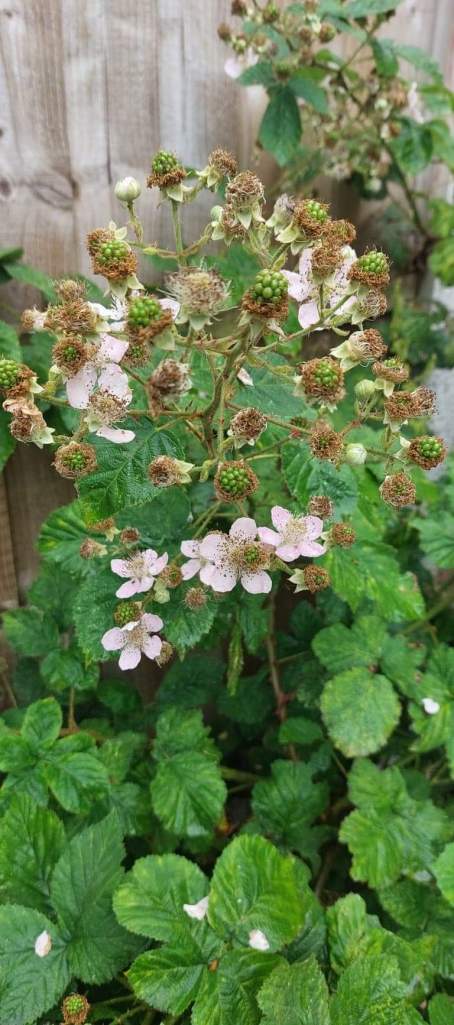
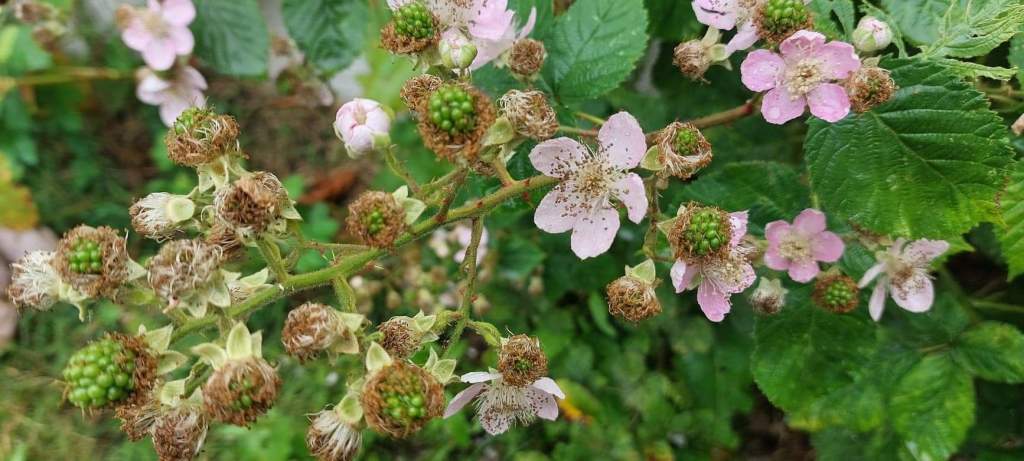
There are potentially hundreds of varieties of the Rubus genus, all of which carry much the same folklore and folk witchcraft applications of protection, boundaries, binding and healing. One of the most common varieties seen in England is the Rubus fruiticosus (European blackberry) and it is from this that so many of us either forage our summer time fruits, or grow it intentionally (as we as a family do here in Lancashire) for fruit harvesting.
(As an aside the young shoots can be eaten like asparagus while the thorns are still soft but, as with the fruits, some plants taste bitter and some delicious. If you live in one of the countries where bramble is introduced and invasive this might be worth making a regular snack.)
As well as being a protector, Rubus is also lovingly known as ‘friend of the poor’ or the ‘travellers friend’. This is down to the plant’s abundance of fruit in the summer which can be processed in a variety of ways to make anything from pie fillings, to jams, preserves, syrups, cordials and even wine! Growing in such an abundance throughout the UK and Ireland it was extremely common for common folk and folk workers alike to forage blackberry for food and medicinal purposes. Even today, many people take delight in foraging for blackberry. Some of my fondest memories from childhood are of foraging for blackberries and bringing them home for my Nan to make her famous blackberry and apple pie. It was so good that I can almost taste the memory as I am typing this! Despite growing blackberries in her own garden, we were never allowed to freely pick from the bush. My Nan would usually save them until the last possible moment when the berries were at their fattest and most juicy. Only then were we allowed to pick them.
And as for picking the early summer bramble flowers, certainly not! This would result in a slapped hand and a telling off because picking the flowers meant depriving the bush of later fruit. If you wanted the flowers for pressing, decoration or workings you had to forage for those elsewhere.
Growing up, my mother and nan taught me how to use bramble within their practiced folkways. This primarily involved making a good sized hoop from a shoot of blackberry vine every early spring. In order to do this, one would need to cut a long and supple vine. More mature vines would be woody in texture and more likely to snap when trying to form the hoop.
Once the long vine of bramble was cut, the practitioner would need to form a hoop from the vine using nothing but their bare hands in the formulation, and weave the vine in and around itself to secure the circular shape. If the hoop bent, cracked, snapped, or came undone, the practitioner would have to start all over again.
I remember on one occasion, I was perhaps about fourteen or so, my mother catching me trying to form a blackberry hoop while wearing my nan’s gardening gloves. A conversation ensued which something like this…
“It won’t work you know.” My mother snorted.
“What do you mean?” I quizzed back.
“You have to show the blackberry no fear of her thorns when you form the hoop. Otherwise the hoop won’t work for anything you want it too. It’s a sacrifice. If she draws blood, then that’s her payment. If she doesn’t, all the better then isn’t it?”
I remember groaning, but seeing her point nonetheless. My Nan had also said similar on occasion. So I removed the gloves and formed the hoop first time. I looked up to see my mother smirking, which to be honest, really pissed me off. “What are you laughing at?” I snapped as only a moody teenager can. “Now you have learnt blackberries other lesson; patience and handle with care, and then she doesn’t bite”. At this point, I rolled my eyes and went indoors to hang the hoop on the back of my bedroom door for protection. As an adult, I am eternally grateful for the folkways I learnt from my mother line, ultimately, it is what led me to find and formulate the witchcraft practice I have today. Though I admit that as a teen I often found it frustrating as I couldn’t understand why my family practiced what was very obviously a form of Witchcraft, but never saw it as such. To them, folk ways was natural, witchcraft was not and associated with danger, condemnation, sail ostracism and even the Devil. As an adult I now, of course, understand the social complexities and differences between folk ways and folk witchcraft and I have spoken about this in some of my other blogs.
As well as being able to be hung for protection, blackberry hoops could be used within healing workings too. In this instance, the hoop would be passed over, or the afflicted area passed through the blackberry hoop to bring healing. For example, I remember the hoop being used for me when I had broken my wrist as a child. I was told to put my hand, complete with cast, through the hoop and then back out again while certain prayers were said. I was then told that this would help the bone heal quicker. I have also used this method for myself and family members alongside medication (I don’t see magic or folkways as a substitute for medicine, but I do see it as a complimentary practice), and have noted that certain injuries and illnesses do seem to improve quicker when bramble hoops are used, compared to when they are not.

Meeting with Rubus.
By now, you may have sussed that as an animistic folk witch I not only work with the spirits of nature (plants and trees included) but that I also see many of them as archetypal figures that we, as humans, can work with to understand both the plant, nature and ourselves better.
My interpretation of Rubus is that of the ‘Queen’ or ‘Empress’ archetype. She reigns supreme in the hedgerow, nurturing and protective. She feeds the poor, advises and guides those who commune with her and is a formidable opponent – just ask the Devil! Despite having a masculine sounding name, Rubus has an undeniably feminine vibe, and yet there are hints of masculinity as well. But this is typical of any Queen or Empress archetype, she has to be able to wield and share the power of her consort the king, something that many female archetypes do not necessarily have the luxury of having or being acknowledged for. However, as well as this, the Queen figure also has the potential to rule alone and be recognised for this, should the King ever fail or die. It is easily argued that the Queen or Empress figure is usually the real power behind any throne, as she has the ultimate influence over masculine power. Within the game of Chess, it is not the King that is the most powerful piece, but the queen.
If you are new to working with Rubus, you’re in for a real treat as she is not a difficult plant ally to work with, especially when treated with respect.
I find certain unspoken rules come into play with Rubus; only take what you need, patience is a virtue and give her space.
Rubus fruiticosus is a plant that, if given the right environment, will sprawl and grow in abundance! She will nourish you with fruit, feed the bees from her flowers, hide and shelter animals who need it and offer divine protection to all who call upon her. But give her too much shade and too little light, constantly prune her to fit your ideal shape for your garden, and she will soon stop sharing her fruits and wisdom. As with any powerful woman, you cannot control her.
Whenever harvesting from Rubus, always do so with care, if you rudely pluck from her vines, she will soon prick you with her tiny thorn swords, and like with any plant, always ask before taking. It’s only polite after all.
Using Bramble.
As well as all of the previously mentioned ways, Bramble can be used in the following.
- Hoops: The hoops can be made and hung by front or back doors for protection, especially during the dark half of the year when strange spirits walk the land more so than the do in summer time. The hoops can also be hung above beds to protect sleeping people from nightmares (I have found this particularly useful for those battling post traumatic stress disorder). I have recently, in the last three years started to hang blackberry over my bed throughout pregnancy, and where possible, have it with me in the labour room. This is because psychic protection often needs to be upped or tweaked in pregnancy to offer the mother and baby additional safeguarding. Pregnancy is a time when good spirits, such as our ancestors, like to gather near to offer us love and guidance. But that spark of new life from a woman being pregnant can be seen clearly in her aura, even when she is not yet ‘showing’ or sporting a bump. This means it can, and has in the past for many women, attracted negative spirits who are attracted to that spark of new life. At some point I will write a blog on psychic protection and supernatural experiences in pregnancy to explain the need for additional protection in pregnancy and phenomena of paranormal experiences in pregnancy in more detail, as it is deserving of a post of it’s very own!
As well as this, and as mentioned before, blackberry hoops can also be used to place by sick beds or have afflicted areas passed through the hoop, this works by not only banishing ill health, but speeding up recovery.
Blackberry hoops can even be beefed up a little to make an almost dream catcher like trap to ensnare negative energies.
- The flowers: Bramble flowers can be used in love workings where a couple may need additional protection. I myself have used this method when a certain woman and occultist did not take kindly to my husband forming a relationship with me after he had politely turned down her advances. This particular person not only took it upon themselves to slate both me and my husband to anyone who would listen, but attempted to send some very nasty energy our way. So, I harvested some bramble flowers, strung them on red thread and hung it above our bed for protection. As well as this, I was nice enough to send back this persons energy with a little extra ‘oomph’ attached for good measure. As I understand it, she didn’t have a good time with health and life for a few months after that, but that’s not my problem. I never start fights, I only finish them. And this person has backed away energetically now. I wonder why…?
I would like to add here that I do not ever advocate for harming other people.
However, a persons right to protect themselves is a paramount human right. Therefore, protecting oneself or loved ones, and sending another persons nasty energy, hexes or curses should not perhaps be viewed as ‘black magic’ but rather as protective and preventative magic. After all, if you successfully send back another person nasty energy, and you do it efficiently enough, they don’t usually try to fire a second time. This is where the preventative aspect comes in.
- Bramble crosses: As well as hoops, some practitioners like to form bramble crosses for protection and hang them up from Samhain to Imbolc. This seems to be a variation of the more traditional rowan cross.
- Bramble thorns: Bramble thorns can be used much like blackthorns are within baneful workings. However, the difference being is that bramble thorns can be used within Babby-Pets and poppets to invoke protection and fire back at anyone firing at you or whoever the poppet is of. They may also make an useful addition to the contents of Witch Bottles or freezer spells.
- Growing blackberry: As well as offering yummy late summer fruits, bramble can be planted near front gates, garden paths or even front and back doors for use in boundary and protection workings. I have found when combined with rosemary and sage (a protection trinity), it makes an almost impenetrable psychic and magical protection fortress. Growing blackberry also has the added benefit of encouraging bees into your garden!
I hope you have enjoyed reading this week’s blog and I wish you a very happy July and week to come.
From the time, mists and distance between us, blessings from me to you.
Zanna
 Diary of a Folk Witch