Subscriber Content
Right, that’s the non subscriber bumph out of the way, let’s grab a cup of tea, a snack, put our feet up and talk folk ways.
Below are a list of some of my most commonly used tools. In reality, I use far more than the listed tools, but I have chosen to discuss only a few of the most relevant as no one needs a blog that goes on for the length of a bible! I also find that listing too many tools, practices, ways etc can be overwhelming to some people, especially if they are new to their path. With that in mind, I try to just plant the seed of information in the hope it will inspire others, not overwhelm them.
Do Folk Witches Really Need Tools?
This can be a contentious topic between some practitioners, especially those who like to apply minimalism to most areas of their day to day lives. Minimalism has become a trendy movement over the last five years or so, and I get it. 20th and 21st century living combined has indoctrinated the every day person into the service of the false god of consumerism. As people, we are targeted on a daily basis by advertisements and sneaky product placements, all designed to make us part with our hard earned cash, and most of the time what we have bought is a bit of plastic tat or an electronic gadget that makes us happy for all of five minutes before leaving us feeling flat again. Neither the Pagan or Occult community have escaped consumerism either, with Witchcore trends being a multi-million dollar industry and the crystal and gem market being even bigger. What is worse, of course, is that the vast majority of crystals are sourced unethically and done so via the use of child labour. And in regards to Witchcore trends… well, the vast majority of those clothes will be made in sweatshops in countries already experiencing high poverty and dangerous work conditions. This alone is often one of the main points for arguments for minimalism in general, but also certainly applicable within witchcraft and paganism too. After all, many branches of both witchcraft and paganism are supposed to be earth based spiritualities, and it could be argued that we are not practicing what we preach if we ourselves are not honouring the earth or life when we over-consume or buy unethical trends.
I don’t necessarily disagree with the idea of minimalism within spirituality, it certainly has merit. However, I am also of the opinion that there is a great benefit to seeking a consumer and practical balance when it comes to accumulating the tools that are used within the practice of folk ways on a daily basis. For anyone who has had the opportunity to explore the brilliant museum of witchcraft in Boscastle, Cornwall, you will see that it has always been common for witches to have some level of basic tools kept and used within their everyday practice. Whether this was horseshoes for apotropaic purposes, pins, witch pins (or nowls), scrying mirrors, etc
For the every day witch, it was to their benefit to have either bought, made or been handed down some tools. Especially if that practitioner was working as the local wise person and offering assistance to the community in exchange for goods or payments. Where a tool could not be obtained by any other means, it could often be made using things the witch had to hand or had foraged.
One of the most fascinating aspects I have noticed about both folk and traditional witchcraft in previous generations is how often the practitioner will make use of every day objects in order to carry out their ways. This powerful form of sympathetic magic could take the form of scissors, use of the best knife and pretty shells that could be passed off as collected trinkets from the beach. All of which could easily pass under the radar and not directly out you for being a Witch.
This was particularly important for for Christians who practiced folk ways. I know my mother started her marriage by keeping most of her tools as inconspicuous as possible, and her crystal ball and tarot cards were kept fairly secret until her later years. This was not unusual, even for practitioners in recent years, but it does offer a fascinating influence for many folk witches. After all, why buy an expensive Athame when you can pick up a pretty knife from a flea market or antique shop. At least that knife has an interesting history and can be passed off as basic every day house tools if needed.
Where a good number of modern neo-pagan witches have no anxiety about openly collecting an abundance of crystals, or a plethora of occult tools, many who practice folk ways still opt to choose more subtle and every day objects to use in practice and display around the home.
For me personally, as usual, I cannot sit comfortably in either camp. I straddle the middle path from growing up around Christian folk magic and mediumship, but then breaking free to explore neo-paganism and Druidry in my 20’s, so some of my tools take influence from my upbringing, such as my scissors, knife, braiding star and blackberry hoop. And others come either from more modern pagan influences or from my research into local regional witchcraft of my now home, Lancashire. My home throughout is relatively normal looking until you reach the front room, where a very obvious altar sit upon a gorgeous welsh dresser.
When it comes down to the tools of the individual witch, I think it is very much up to them how much or how little they need or own. Ideally, it is always better to buy ethical tools, forage responsibly and either make your own or support local artists where possible. But at the same time, it isn’t uncommon for new seekers to buy every occult toy they see when they first take tentative steps on their journey. Many of those tools will lie forgotten in time, unused and dusty. I choose not to judge those who do this, it’s better to lead by example. After all, in time they will tend to find their stride and their confidence will grow. Todays seeker may be an expert wand or staff maker in ten years time, foraging ethically and selling at local camps or online. The one who buys all of their herbs from Amazon may end up one day being a medical herbalist who grows and harvests their own crops. How we get from A to B on our journey is what is important, but that also includes all of the trials and errors too.
Witch Pins, hooks and needles.
Historically speaking, both pins and needles were highly coveted by witches. They could be used in every day dress making, but also had magical applications within folk ways, for both healing and curses. In 1612, young Alizon Device accosted an elderly pedlar along a country road in Pendle, Lancashire. She begged of him some pins (much suspected to be used within witchcraft), and when John Law refused, Alizon shouted a curse at him. A curse that caused what is thought to have been a stroke, thus instigating the Pendle Witch trials. An infamous trial that would later go onto influence both the Essex witch trials, and more staggeringly, the Salem Witch trials in America. It is astounding to think that the begging of pins led to the death of dozens and dozens of innocent people from 1612, all the way to at least 1692.
Pins are regularly associated with poppet work, and thereby also unfortunately tied in with ‘black magic’. However, pins can be inserted into poppets for healing workings too, almost like acupuncture. We see this in local Anglo-Celtic Witchcraft as well as in the African American religion of Voodoo. There is a fascinating custom in some voodoo practices of creating dolls of both a bride and groom. At the wedding, guests are encouraged to insert pins strategically into different parts of the bride and groom dolls. The heart for love, the womb or penis for fertility etc. It also is not unheard of to also pin dollar bills to the dolls too. A sympatric magic act to ensure the couple are never without money.
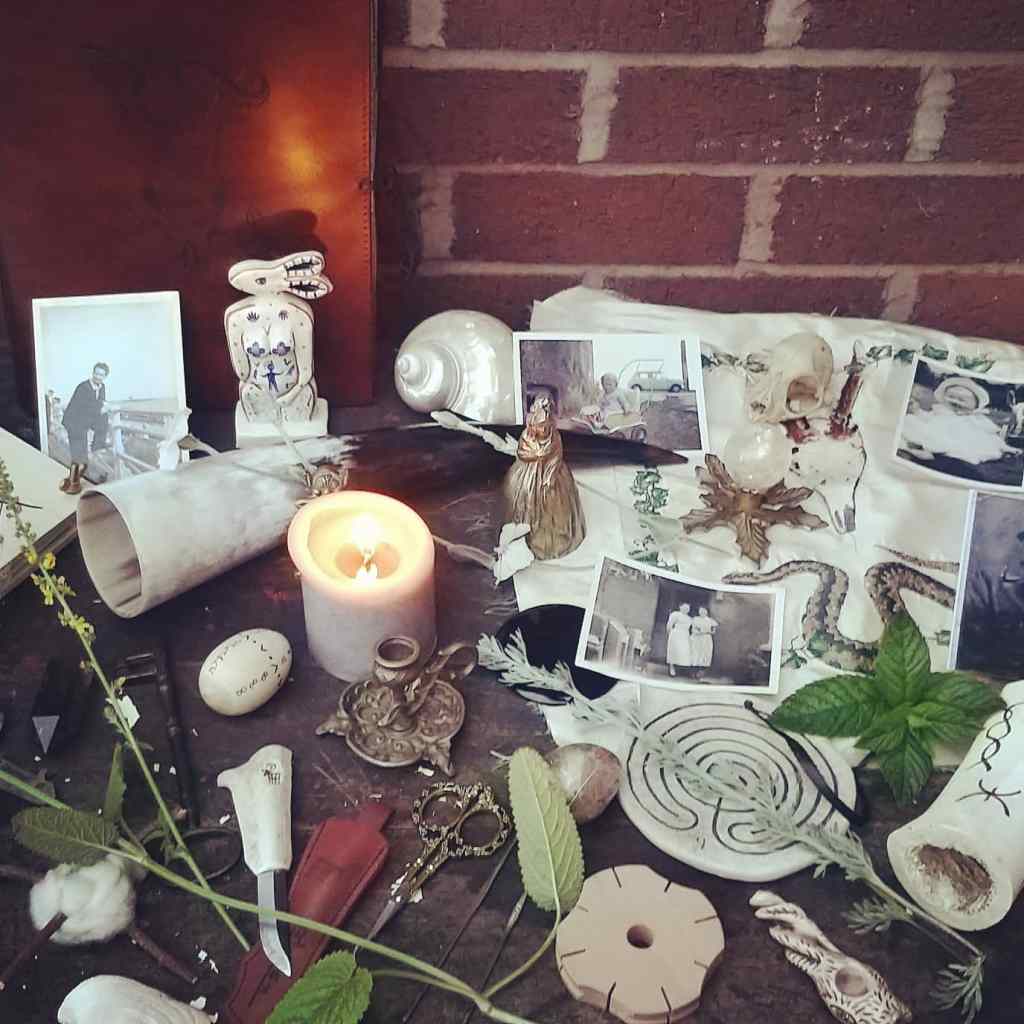
Within my own practice, I use pins and needles in a variety of ways. I use them in healing workings and understand that they can also be used for harm. I use them to hold down energy, especially in sewing workings, and I also use them in witch bottles for protection purposes.
As well as every day pins and needles, I also own two ‘witch pins’ (sometimes called nowls). Witch pins can take various forms, such as coffin nails, railways spikes or even garden fork prongs. In recent years, some very artistic nowls are being made by artists, and I was lucky enough to be gifted one by my husband a couple of years ago. Witch pins are often used to pin down energy – for example, they can be driven into the footprint of an enemy in order to halt them in their own workings. They can be driven into graves for a year and a day to stop the dead from rising and haunting the living, and they can also be used to draw upon local land energy and bring it home with you. Almost like charging a phone and taking it everywhere with you, a nowl or witch pin can be driven into a place of significance for a day, week, full moon, sabbat etc, and then taken home with you to use that energy as you will. I sometimes plant my witch pin by water to bring home for healing workings, or near cross roads for divination purposes.
The crochet hook is probably one of my favourite inconspicuous tools of witchery and comes straight from my mother line. I was brought up being taught of the every day power of artistic crafting. Magic and intention could be sewn into a patchwork quilt, intentions and chants could be worked into every stitch of crochet or knitting. Dropped stitches were unlucky and meant unravelling the whole row and retracing your steps to set the row to right. Every colour thread or yarn had a symbolic meaning and combining certain colours could create a powerful energy alliance. I remember when my second daughter was born, she was very ill and spent the first five months of her life in a children’s hospital. It was awful, we didn’t know from one to the next whether or not she would survive. As parents we were warned that she needed major surgery if she was to have any chance of survival. As I sat by her cot, watching her slowly breathe, and unable to pick her up due to how many wires she was hooked up to, I decided to do the only thing I could do. I began making a small healing a protection blanket, using a 4.5mm crochet hook, blue and purple yarn. Every single one of the thousands of stitches that made up that blanket had various prayers and chants spoken over them. I entered a deep almost trance like state, and to this day, I do not fully remember the three or four days it took to make the blanket while we waited for a surgical slot, but I made the blanket and it hummed with magic.
On the day she was taken down to surgery, I draped the blanket over my daughter, hoping my magic would be enough to help her. And perhaps it was, as although she ‘crashed’ after surgery and her SATS dropped to a critical 40, which meant that she needed to be intubated, she survived – against all the odds. This sort of magic of sacrifice and labour of love is well known to the folk witch, as is the power behind it. For mothers, it’s a creative form of sympathetic magic we often fall on to when needed. For me it is crochet, for others it may be drawing or sewing, etc

Knife And Scissors.
Both of these tools are fairly direct and uncomplicated. The knife is used to direct energy and is phallic in shape, so often associated with masculine energy. It can be used in every day practices of foraging and gardening, or within ritual to blood let, cut ties, or direct energy around the circle.
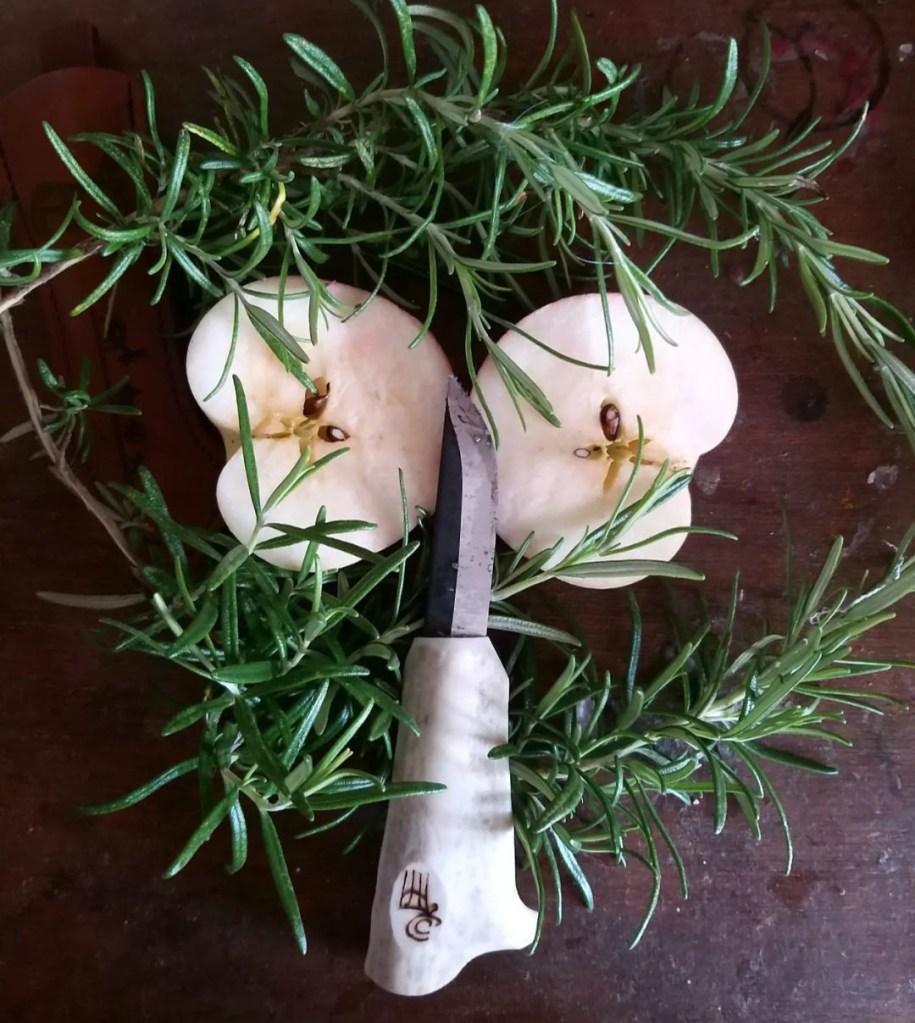
My bone handled knife is primarily used to mark symbols on to candles, strip bark or harvest herbs and plants when I am foraging.
Scissors are also used within cutting magic, but somewhat more specifically. Scissors can cut cords, including umbilical cords. (Some families keep special pairs that are sterilized and used in home or hospital births and are a family symbol of birth, connection and transition. Note, if you’re not familiar with this practice, please do not try it without researching it’s, safety, risk of infection, cord and placental care, type of scissors needed, etc).
Scissors are also used in ribbon and releasing workings, to cut hair sacredly or to cut fabric or other materials used in workings. The scissors represent change, transition and creation. In hair magic, the hair can be cut and collected for protection workings, and then usually braided for safekeeping. One Lancashire family also keep their working scissors for a child’s first ever hair cut, believing it is unlucky to cut a child’s hair or take a lock before their third birthday, and when a lock must be taken, it must be taken by a family member only, and using the family scissors. It is equally important to not throw the lock away, that it should be kept until the child’s sixteenth birthday and then gifted back to them for luck.
Cords And Braiding Stars.
I’ve forgotten how long I’ve owned my original braiding star, it possibly goes back to my childhood. As a child I was taught how to use it in order to make cats cradle cords, laces and so on. As I got older, I was shown how the braiding star could be used to make cords used in folk way workings. Sometimes for bindings, sometimes for healings and mendings, other times, to form the base to hang a charm from. As as adult, I have a newer braiding star that I use in all sorts of workings. At present, it is currently weaving a red cord that will have various hag stones hung along it for protection. This charm will hang in the garden, the house I currently live in is currently smack bang on an old boundary line that until about seventy years ago, separated two farms. Living on any liminal spot such as this, by a water source, cross roads etc means you can sometimes experience slightly more psychic phenomena than other places. The hag stone charm should keep the garden ticking over nicely, and it will be hung up in time before the wheel of the year turns again and we start to wander deeper in to the darker half of the year.
Cords made by braiding stars can also form a wonderful base for a witches ladder, and providing you do not weave too tightly through the star, your end cord will be slightly slack enough to thread through feathers, attach charms and so on.

Mirrors
Mirrors have a long history of occult use from all over the world, mixed with the belief that anything that can hold or portray a persons image has magic and power. Mirrors made from polished metals, prior to the regular availability of glass mirrors, were used to scry or speak with the dead. The mirror was believed to be a portal that finely separated us, in the world of the living, from those in the realm of the dead. This liminal connection between the living and the dead is one of the many reasons why many people still carry out the age old custom of covering mirrors when a loved one dies, for fear that the spirit of the loved one would become trapped in the liminal space of the mirror. Forever unable to be in either the realm of the living or of the dead.
I still practice this custom, and sadly had to cover my mirrors several times throughout the pandemic, out of respect for the dead. Ideally, the mirrors would be covered from the time of death until the persons funeral. But with severely delayed funerals due to the terrible and unprecedented amount of fatalities caused by Coronavirus, some funerals were taking up to three months to be held. In cases such as this, I chose to uncover my mirrors earlier than usual and implemented other precautions instead.
In regards to divination, mirrors and reflective surfaces form a wonderful gateway to the space between, there are many documented examples of mirror magic, both in children’s fairy tales (such as snow white, where the evil queen communes with a ‘slave in the magic mirror’) to early Irish-American Halloween customs that would encourage young girls to brush their hair in front of a mirror on All Hallows Eve, while eating an apple. This act would supposedly conjure up the image of the man she was fated to marry. And lets not forget such urban myths as ‘Bloody Mary’, where saying her name (or alternatively, “Bloody Mary, I have stolen your baby”) three times in front of a mirror would supposedly summon her terrifying presence.
For the folk witch however, we tend to not engage with such childish divination games, instead preferring to use normal or specific black scrying mirrors in order to scry and speak with spirit. For an example of using mirrors for scrying, please check out my earlier blog on corpse roads.
As well as this, myself and other folk witches like to use mirrors for protective purposes. For anyone who visits my home, as soon as the front door is opened, they are immediately greeted with a very large pine framed mirror reflecting directly back at them. This is intentionally placed as it reflects a persons own energy straight back at them. If their energy is good, kind and well meaning, the mirror doesn’t phase them. If however, their intentions are not good, the mirror and their own reflection starring back at them is unsettling and disarming.
On an every day practical level, I find mirror magic very useful. Interestingly enough, it helps with all of the annoying door to door businesses that like to knock on the door. I have noticed the times a so called charity worker or business representative has knocked on the door the trustworthy ones with ID’s don’t even notice the mirror behind me and reflecting themselves. But on the odd occasion a canvasser has called without ID, or seems odd, they have gone from confident to stumbling and distracted as soon as they are faced with their own reflection. When you’re an unpleasant person, sometimes the hardest person to face is yourself…

Journals And Grimoires.
Books of shadows and grimoires have become very popular with the neo-pagan boom of the 20th century. The influence of Wicca has been far reaching and even fashionable. Spell books and grimoires were not always as common for the every day folk witch of old. This was largely because of class and demographic reasons. As discussed in previous blogs, the politics behind class and folk witchcraft is complicated. Folk Witchery was the every day magic of the lower and working classes, their practical sympathetic and get things done magic as a way of survival and spiritual connection. It’s therefore important to note that prior to the mid 20th century, much of the lower and working classes were in fact illiterate, and being so meant it was not so common to keep a magical record of what they practiced. This is why, in places such as here in Lancashire, family lines of folk ways were so important. It meant that people could hand down ways from one generation to the next in person, while at the same time avoid keeping incriminating evidence that could identify you as a witch. The idea of huge swathes of the British public being illiterate well into the 20th century may seem far fetched, but it’s not at all. Especially when you take into account family profession and demographics. My own maternal great grandmother was illiterate and refused to learn how to read as an adult for fear and shame. She passed away in 1992 with only the basic ability of writing her name and understanding a few written sentences. Another relative, a miner from the North of England on my mother’s father’s side could not read because he had never attended school and said “you don’t need to read when you spend all day in the darkness of the pit”. He did however ensure his own children could read and when one of his sons, my great grandfather, grew up, he intentionally moved his family, after the war, from Newcastle to London, so that his children could receive a better education and not have a life working in the pits. My mother and her parents both shared a great love of reading and writing, and that in turn has been passed down to me. My maternal grandmother kept no book of shadows or grimoire, but she did keep a very basic notebook of various remedies, folk ways and recipes that she thought to the useful. And in turn, my mother kept a pretty scrapbook with unicorns on the front cover. She called this book her book of ‘ways and means’, a place where she wrote prayers, chants, recipes, folk ways and memories. My mother was a much better artist than I am, and she would decorate edges of pages with beautiful flowers to compliment her work, that was all written by hand in delicate calligraphy.
Growing up amongst folkways and then going off to explore neo paganism has meant my own grimoire is a blend of both neo pagan influence and of the folk ways that I grew up with. I don’t have a simple note pad or a pretty scrapbook, instead I have a commissioned grimoire, made to my own design by Earthworks Journals.
It has a very Occult style and yet the inside is set out much like my mother’s and grandmother’s journals and note pads; endless pages of experiences, knowledge, prayers, folk wisdom, workings, chants, correspondences, herbal remedies, folklore and more. I have also recently taken to cutting out excerpts of each of the previous years almanacs and sticking in relevant pieces of information that I find handy, or old folk art that compliments my writing. My own book of ways is a personal collection of learned knowledge from many years practice, something I can re-refer back to and hopefully one day, pass down to one of my own children.
Salt, Soil, Sand, Waters, And Herbs.
Salt, soil, sand, waters and herbs form the basis of most of a folk witches workings and so samples of all are often collected and highly prized. I myself love to collect water from any sacred wells or lakes that I visit, and both my husband and I like to collect sea water in order to make our own sea salt. The process of making salt is really quite simple and largely involves boiling and stirring salt water until all that is left after the evaporation of the water is the salt minerals. In turn, the salt is used in cleansing and banishing workings as well as used in offerings within ritual.
Another quirk of mine is the habit of collecting soil. Until recently, when the jar accidentally smashed while moving home, I had been collecting graveyard soil from various interesting churchyards around the country. From Devon and Cornwall, London and Suffolk, all the way to here here in Lancashire. I wouldn’t collect just any old graveyard soil, oh no. It had to be from areas that either specifically called to me or had interesting folk lore, pagan lore (such as churches built on older pagan sites) or relevant associated witch lore. All of the collected soil would be used in scrying protecting, banishing, and if needed, blasting workings. Now I begin the task of collecting again, but as well as this, I also plan to collect soil from any neolithic sites visited too (from outlying areas only for obvious reasons), for additional workings.
Sand, seaweed, and shells are also collected, these can be used in workings where you want to absorb negative energy from one place and then transport it to another. This could be as simple as burying the used sand etc so that it can return to the earth and become neutral, or sprinkling the used items on the property of an enemy. Personally however, I just bury the sands etc or pour them into a river or brook that flows in the direction away from me so that they can be taken away and return to the earth to become new.
Like many other folk witches, I both grow and forage many of my own herbs and plants. Some are used in workings and offerings, others are used for medicinal and culinary purposes. Growing and foraging for necessary plant life has the added benefit of not only connecting the witch deeply to their natural surroundings, it’s spirits and landscape, but also by increasing knowledge and understanding. Throughout my teens and early 20’s I bought the vast majority of most of my herbs from places such as Starchild in Glastonbury. And where Starchild sell a fantastic range of organic botanicals, using them alone was stunting my growth. In the years I have spent learning to identify and grow my own produce, my practice has greatly deepened and expanded, I can now grow, harvest and identify many plants, trees, fungi, herbs etc. This learning has offered me independence from consumerism and a trust in my own knowledge and applications. Not only this, but learning to understand plants has introduced me to the world of plant spirit; spirits who in turn have become powerful magical allies. Learning to grow and forage my own herbs has also prompted me to learn ways of storing a preserving what I need. I now know how to dry, dehydrate, powder, tincture, ferment and more! These are skills I would not have if I was still relying on store bought herbs.
Natural tools; Crystals, Hag Stones, Fossils And Shells.
As well as foraging for all of the above mentioned items, I also like to search out for other natural tools that compliment my practice. Such as the hag stones that are found abundantly on the east coast, jet, fossils, shells and even crystals. Lake Bala in North Wales has an abundance of a unique quartz crystal that can be used in workings or crystal therapies just as well as any fancy piece of store bought clear quartz. Some of my tools are bought items, such as my beautiful Ammonite that is used in purification workings, or my hedge stone used in scrying, but I find it rare to now see an item in a store and look at it and say “Oh yes, that’s the right tool for me!”. There is something incredibly powerful about using items that have come to you in nature, they sing to you and together you form a mutual relationship for workings. They become an ally and a friend, and one day you know that should there ever come a time when you and the tool no longer need to work together, you can return it to the earth for them to have a new chapter in their existence. After all, most of the naturally found tools a folk witch has found are anything from thousands to millions of years old. They had a life before you, and will have one after you.

Thank you very much for reading this week’s blog, I hope you enjoyed it. Let me know down in the comments what you thought, because I am happy to do a part two to this blog next month listing tools specifically used within divination for the folk witch.
Though the time, mists and distance between us, blessings from me to you.
 Diary of a Folk Witch