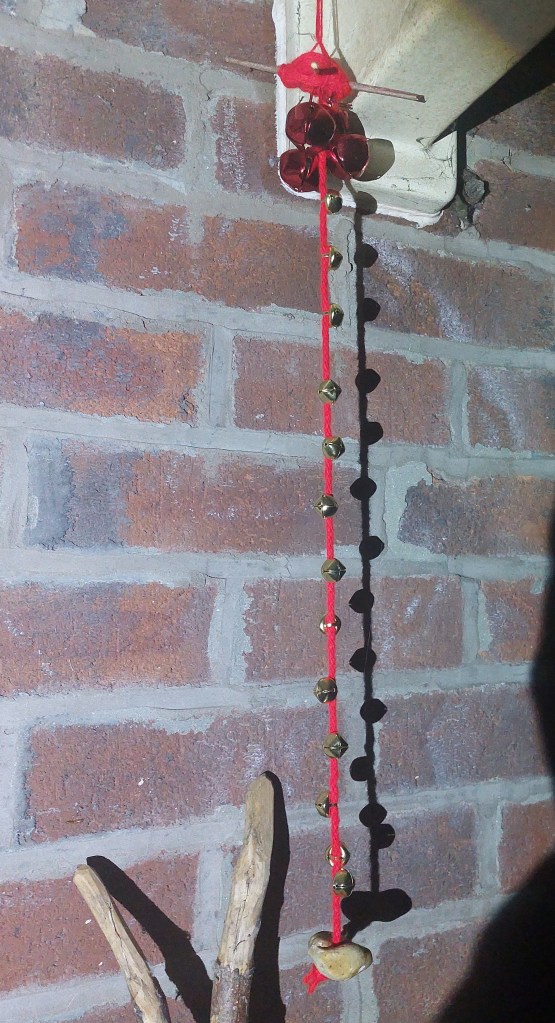
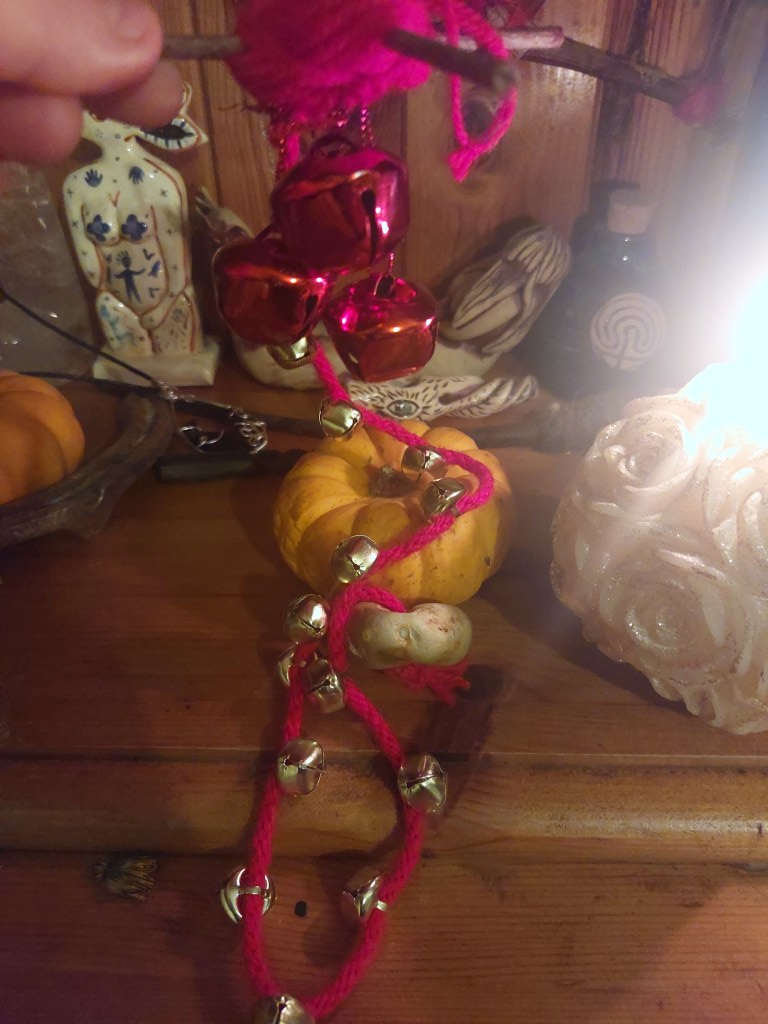
This week, as part of the Grimoire series, I am going to be offering you a written tutorial on how to make this gorgeous, and rather festive looking, red bell charm for protection. A charm utilised mostly during what many of us refer to as ‘the dark half of the year’. The period of Samhain to Imbolc.
So, grab yourself a warm cup of your favourite brew, sit down and put your feet up while I take you on a ‘how to’ for making your own version of this charm!
Obviously within the realms of folk magic and folk ways, there are far more workings than protection workings alone! However, since the last blog from the folk witchcraft series specifically spoke on the topic of protection charms for the home, I thought it might offer a nice sense of continuity to the topic if I shared with you all how to create an effective charm of your very own.
This charm is called the red bell charm and is used to ward away dark or malefic spirits who tend to roam the earth more after Samhain for the darker half of the year. One folk witch I know of who makes a very similar charm hangs hers up on December 1st to ward away the Krampus, as her cultural and ancestral background is Swedish-Dutch.
Others use such charms for a more generic source of protection – as I do.
Living where I do in Lancashire, which is a stone’s throw from wild moorlands, I have come to observe that certain land spirits become more active at certain times of the year. For example, some feeorin (fairies) will be ore obviously present from Beltane to Summer Solstice. Ancestral visitations (ghosts) in October until All Souls Day on November 1st, etc
And for where I am, near the moorlands, certain spirits come down from the moors to more suburban areas when the wind seems to pick up and seemingly almost blow them this way, between mid-October to the end of January.
I do not fully believe that these seemingly nameless local spirits are blown down in a physical sense by the northern winds that can sweep through such counties as Lancashire and Yorkshire, but they are far more apparent during bad weather and heavy fog then at any other time. What is unusual is that there is not seemingly one universally accepted name for these spirits. Some call them Boggarts, others ‘wisps’ and some just offer vague names such as ‘them of the moor’. But they have one thing in common, and that is the behavioural traits of all of them – which leads me to believe that despite all the differing names, they are in fact one breed of local land spirit.
Behaviourally, these moorland spirits fill areas, gardens or homes with a strong sense of foreboding. Like a nameless fear is watching you, but from a direction you cannot quite pinpoint. They also seem to swallow all sound and make the vicinity seem to fall into an unearthly silence. For those who have been unfortunate enough to have these entities enter their homes, they have found electricity to flicker or go out completely, experience shuffling or knocking sounds from somewhere nearby, but are unable to trace the exact source of the sound. Some encounters have also blamed family deaths on these ‘them of the moor’.
The last time I felt their presence was about two weeks ago. The winds were howling and screeching like Bansidhe in the night, and yet despite the wind – the atmosphere outside felt remarkably still. A heavy fog filled the air and a sense of being watched filled both my husband and I from the front porch when we went out to observe the weather.
Inside the house was warm and safe though. As a practicing witch of over twenty years, I keep my home like a spiritual Fort Knox. Very little, unless expressly invited, gets in! This means I could lay in bed that night and listen to this very atmospheric wind and occasional howls that sounded more unearthly than weather like from an observer point only…. and not someone plagued by these occasional but unsettling hauntings.
Part of the reason my home is so well spiritually and psychically protected is because of my implementation of certain charms and ways. Some of which are seasonal, like this, the red bell charm. Others, like those mentioned in the last blog are more permenant fixtures in the home.
I hope you enjoy making this rather pretty and festive looking charm! If you do make it, why not share a photo over on the private Facebook group ‘Diary Of A Folk Witch’ so we can all admire your work!
Note: If you’re a subscriber and not yet a member of the Facebook group and would like to be, please drop me an email to Diaryofafolkwitch@gmail.com
Tools Needed (And Symbology/Meaning).
Red Yarn or Wool (to make the main cord, that will be braided with a braiding star or by hand with a plait. Red is a power colour for protection and the power held within a witch’s blood. Red is also the colour of Rowan, a tree heavily associated with protection).
Braiding Star (If you want to. If not, simply braid the cord in a plait).
Four medium-large bells of either red or gold – or both (red for protection, gold for the power of the divine/gods/ancestors etc. Bells have a long association of warding away evil, especially in Christo-European lore which associates the ring of bells with the catholic mass, ringing out evil, purifying, and bringing in the light and love of the Judaic-Christian god)).
Thirteen Silver or Gold Bells: for the length of the cord.
Two twigs of Rowan to form a Rowan Cross (for protection, you will also need further red yarn or wool to bind these two twigs together).
One Hag stone (for protection against unseelie fey and other such spirits).
Scissors (for cutting cords and tidying ends)
Instructions:
- Prepare a working space, either your altar, a table or some other suitable space to sit comfortably and lay out your tools to work.
- Make sure the area is clean and tidy so that your entire focus is on the working at hand.
- Lay out all of your tools and check you have everything you need.
- In a way that is most comfortable to you, charge the tools in front of you with the intention you have. To create a magical tool used for the protection of yours or a loved one’s home. Focus on the parameters of your working.
How long will this working be used for? A week, a month? Seasonally or for as long as you need it?
What exactly are you protecting your home from? Is it a very specific local spirit, or negative entities in general?
Is the charm complete as it is, or do you wish to make any adjustments or modifications? - Once you have done this, charge the working further by offering up a prayer of protection – either one you have written yourself that calls upon any deity or spirit you work with, or a prayer you know and trust from whatever religious or spiritual background you resonate with. I have chosen not to submit a specific prayer here for this as Diary Of a Folk Witch is an enabling learning platform and I do not want to over perscribe or influence the creative flow of subscribers. Instead, I offer a basic framework and the encouragement for readers to add in their own flavour of practice and power.
- Begin the working now by taking either three lengths of red cord (to a length of your choice- I usually choose from middle fingertip to shoulder for this sort of working length- the length of the witch’s dominant arm), or, if you are using a braiding start- take the required seven pieces of red cord/yarn or wool. If you are doing a braided plait for this working and you find only three pieces of cord or yarn is too thin to make the main shaft of the cord, feel free to double up and take six or even twelve lengths or yarn to make your plait thicker.
- When you are ready, tie a knot in one end of you pieces of yarn, ensuring that you leave enough lengh left over to tie a hag stone at the end of the working .
- Now, begin to braid or plait your length of cord. For this, I strongly suggest using some form of chant or repetitive calling to build power into your charm. Some people might like the old “by knot of one, this string I tie…” verse, for others you might like to use something else. When I performed this working, I recited the following over and over until I fell into an almost meditative/trance like state.
“This cord I tie, this length I bind,
this charm of protection for me and mine.
One braid from me,
One from the gods,
One from the ancestors, all made into one.
One knot for goodness,
One knot for strength,
One then for shielding, and it is done”. - As you recite this or a similar chant or prayer over and over again, you will likely feel the power of the working building in your hands. Your hands may feel very warm, pulsate, or for those who practice reiki – you may feel a similar energy pulse between you and the charm. This is normal and to be expected.
- Once you have reached a braided length of cord that you are happy with, you may tie off the end, ensuring that you have enough cord left over to tie it to the rowan cross.
- Next, take up your rowan cross and kiss each twig and say:
“Blessed Rowan, mountain ash from the lands of home,
bless this charm with your protection, fill it with your power.
Rowan my ally, Rowan my friend, lend me your aid on this day/night” - Once this is done, take a new length of red cord and bind both sticks together so that they form an X like cross. I find it beneficial to hum while i do this. It can be an intuitive tune, or the tune of a song you know. For me personally, I use the melody to the ‘Pendle folk song’ as it’s a tune that connects me to my local landscape and the energies around me. The purpose of humming magic is like with repetitive chanting. It helps to raise energy and maintain focus. And in my case, where I am making a charm to protect my home from local unseelie fey, and using locally sourced Rowan, it helps to add additional local magick by humming an old regional folk song.
- Now you have made your Rowan cross, you may use the left-over cord from the main braid to affix it to the cross. If you can, do a simple knot and use any excess to form a loop that will help you hang up the charm.
- Now, take your thirteen bells and either thread them, so that they are evenly spaced along the length of cord, or, if you are unable to thread the bells, either stich them or fix them in place some other way that is suitable for your spell. Thirteen bells are used in this working as there are thirteen full moons in a year, and where many see the number thirteen as ‘unlucky’, many Witches actually see it as lucky and beneficial. In part because so many rituals and workings require a year (12 months) a day’s (overlap into the thirteenth month) as a sacred time frame for dedications and manifestations.
- Once your bells are threaded, you may now use the remaining cord to attach the hag stone to the bottom of the charm!
- At this point, you may wish to further bless or charge your completed charm. For me personally, I chose to sain mine using sacred herbs and then recite a protection prayer. Others may like to sprinkle holy or some other sacred well water, oils etc over the finished working.
- The Red bell charm is now ready to be hung! For this, you can choose to hang this outside your front door (or just inside if you want to be more secretive in your occult interests). Failing this, you can also hang it by a back door or fireplace if you feel that these areas of the house are more susceptible to intrusion.
I hope that you enjoyed this week’s blog and that it has offered you some inspiration in some way! Please feel free to add this working to your own grimoire, journal or book of shadows – Just remember to also write down where you got it from. Unfortunately, my original grimoire from my younger years is filled with uncredited work and I now have no clue which ones I wrote, and which ones should be credited to someone else. Meaning I cannot ethically share them with others.
Through the times, mists and distance between us, blessings from me to you.
 Diary of a Folk Witch