

There are many ‘mythological creatures’, or as many of us Witches prefer to call them, spirits of the land, here in these beautiful Celtic isles.
Each of them with their very own unique forms, functions and personalities.
Here in Lancashire, in the North West of England, we are no stranger to demons, goblins, long leggedy beasties, and things that go bump in the night!
Lancashire boasts of Spectral Cats, Demon Pigs, worm-like Dragons, Faeries, Green Dobbies, Headless Phantoms, Bannister Dolls, and more.
Perhaps two of our most famous, and somewhat complicated of spirits of the land are that of the Boggart and the Skriker.
The reason for the haunting complexity of these two beings is that they are difficult to pin down and really fully understand.
For example, the Boggart is a living contradiction.
In many accounts, Boggart’s seem to have no set form, and will usually adopt a guise that they know will scare their intended victim the most.
Yet in other tales, the Boggart has no form at all and is an invisible force to be reckoned with!
In some tales they are helpful house spirits, much like that of the Brownie. Whereas in others, the Boggart is a troublesome ghoul that behaves in a similar way to a Poltergeist. Which begs the question, could Boggarts be a regional version of a traditional poltergeist or are they something different?
Subscriber Content
Leaving this theory aside for just a minute, lets look at what we know about the Boggart.
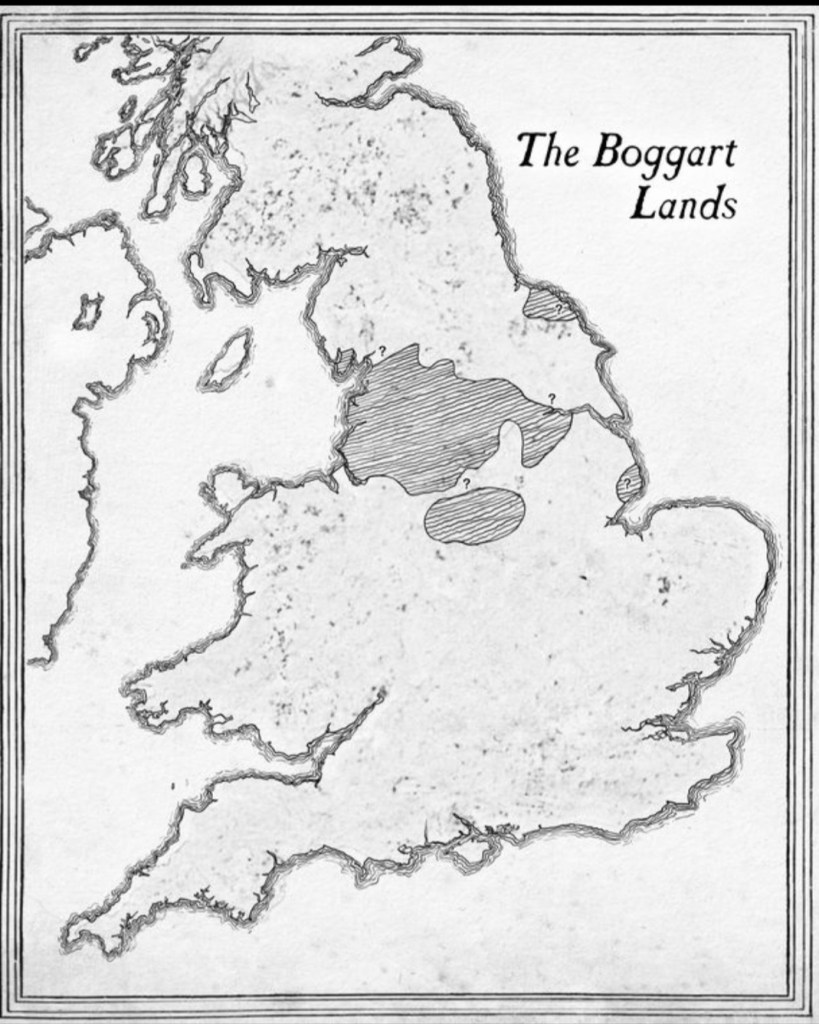
- Boggarts are predominantly thought of as an English creature that is sometimes lumped into one of the following categories; Demon, Faerie (Or here in Lancashire, Feorin), Goblin, or Cryptozoological entity.
However, within my own and some other Witches’ practices, we acknowledge them simply as ‘spirits of the land’. Most commonly though, Boggarts are treated as a member of the local Faerie (or Feorin race).
Where the Boggart is often heavily associated with the upper Midlands and North of England, this creature seemingly does have ‘cousins’ in both the Isle of Man, where they are called Bugganes, and also in Ireland, as Púca, or as the Welsh Pwca.
Growing up in an Anglo-Irish family, I remember many a tale about the Púca and other such members of the Fearie or Sidhe.
In fact, my family is said to have one attached to it! The Púca will misbehave when and if there is a family feud, will help find lost objects for family members it likes, appear as an omen if someone in the family is about to get sick or have an accident, and will make loud knocking noises within walls and loft spaces when someone in the family is near death.
Interestingly though, our family Púca is seemingly not grounded to one locality, or with only one branch of the family. This is a clear difference between it’s Boggart cousin, as although the Boggart can travel about at will, it does usually prefer to haunt one locality, and when it is attached to a family, it seems to stay with just the one branch of that family unit.
I have had experiences of the family Púca here in Lancashire as recently as last year when a sibling of mine was gravely unwell, and others have experienced the Púca’s presence both in London and back in Ireland. - Boggarts are primarily found in the North of England, namely Lancashire and Yorkshire.
- Boggarts are known to reside in wild places of nature, such as moorlands, heathland, bog land, marshes, woodlands and even large parks. Though the park association seems to be a new addition to Boggart lore due to the park ‘Boggart Hole Clough’ in Manchester (formerly Lancashire) and it’s subsequent urban folklore.
- Whereas individual Boggarts are associated with many different places, they do seem to prefer the liminal locations within the place in which they haunt. For example, gateways, doorways, near bridges, cemetery edges, moorland pools and so on.
Within the home, when they do make their presence known, they are heard knocking not on walls, but seemingly from inside them! As well as this, glimpses of the Boggart are said to be seen standing behind you as you face a mirror, or can be heard tapping on or smashing windows. - As well as being associated with open land, the Boggart is of course also known to be a form of house spirit. Either faithfully serving a household, or being a terrible force for evil and mischief!
- As well as being formless in some tales, it is not known if the Boggart has a gender, as in most folklore and urban myth accounts, the Boggart is a shapeshifter and can take any form they want to.
- Boggarts are temperamental creatures and easily offended. In stories relating to house helper Boggarts, it’s only when the Boggart feels slighted or outrightly offended do they become aggressive or a pest. Like other house spirits of lore, the things the Boggart takes offence to can be somewhat trivial in actions.
Boggart etymology.
Well, where to start when it comes to the etymology of this spirits name! It’s almost as complex as the creature itself!
If we look at ‘Lancashire Folk-lore’ by John Hartland and TT Wilkinson, it states:
“Brand says that “In the Northern parts of England,
ghost is pronounced gheist and guest. Hence bar-guest, or bar-gheist.
Many streets are haunted by a guest, who assumes many strange
appearances, as a mastiff-dog, &c.
It is a corruption of the Anglo Saxon gast, spiritus, anima.”
Brand might have added that bar is a term for gate in the the
North, and that all gates of York are named ‘bars’, so that a
bar-gheist is literally a gate-ghost; and many are the tales of
strange appearances suddenly seen perched on the top of
a gate or fence, where they sometimes leaped upon the
shoulders of the scared passenger. Drake, in his Eboracum,
says (Appendix, p.7, “I have been so frightened with stories
of the barguest when I was a young child, that I cannot help
throwing away an etymology upon it. I suppose it comes from
the Anglo-Saxon burh, a town, and gast, a ghost, and so
signifies a town sprite. N.B.- guest is in the Belgic and Teutonic
softened into gheist and geyst”
‘Lancashire Folk-lore’, Page 49-50.
Above, we see clear links to Anglo-Saxon influences, but as well as this, we also have our localised Celtic and middle English influences too!
For example the middle English Bugge, meaning to frighten or scare (a linguistic place where we also may source our word for ‘bug’, as in the creepy crawly kind).
In Scotland there is the Bogill, and in Wales there is the Bwg, both roughly translating as goblin or ghost. However these Celtic influences cannot be ruled out as being free from Saxon and other European influence
One interesting take on the etymology of the Boggart, is the below quote taken from Online Etymology Dictionary:
“Probably connected with Scottish bogill “goblin, bugbear,” or obsolete Welsh bwg “ghost, goblin” (compare Welsh bwgwl “threat,” earlier “fear,” Middle Irish bocanách “supernatural being”). Some speculate that these words are from a root meaning “goat” (see buck (n.1)) and represent originally a goat-like spectre. Compare also bogey (n.1) and Puck. Middle English Compendium compares Low German bögge, böggel-mann “goblin.” Perhaps influenced in meaning by Old English -budda used in compounds for “beetle” (compare Low German budde “louse, grub,” Middle Low German buddech “thick, swollen”)”.
Boggarts as house spirits.
To have a Boggart take up residence within ones home can be a mixed blessing at best. In practically every local folktale relating to the Boggart (within the North of England) the story tells of a Boggart within a home in one of two situations.
Either a family (usually a farming family) have a helpful spirit that assists around the house and farm, until it is inadvertently offended. Whereupon it will either stay and cause mischief, or flee entirely taking with it whatever blessings it might have imbued on the family.
Or a family are living in a property where, for seemingly no obvious reason, a Boggart is playing merry hell. Either way, the Boggart ends up leaving chaos in it’s wake. Unfortunately, this seems to be because this particular spirit is quite a capricious one, easily taking offence at practically anything. In some cases, a home owner only has to acknowledge the Boggarts presence for it to take umbrage and leave! In other tales, it is only when the Boggart is openly thanked for it’s worked, or is given a gift that it either leaves entirely or begins to cause trouble. This is interesting, as it echoes other Celtic Faerie lore, where it is seen as extremely rude and uncouth to thank a member of the Sidhe for any assistance they have given a human.
Boggarts and Poltergeists.
When we observe the Boggart’s behaviour in homes, where it is causing havoc, alongside the above etymology, it is possible that there is a link between both the Poltergeist and the Boggart. As most of us know, Poltergeist roughly translates as ‘noisy ghost’, and like the Boggart (and one of it’s original names or Bargeist), it can move furniture, break things, make loud noises, and basically scare the hell out of anyone living in the home.
However, in most accounts, it would seem that the Boggart never hurts anyone physically, instead it behaves more like an intense prankster who wants to scare people and get attention. Where the Poltergeist does have documented experiences where it has supposedly caused physical and emotional harm, or in some way physically made contact with a victim. For example, with the case of the Enfield Poltergeist, London, England, 1979.
There is some debate within paranormal and occult circles as to whether a Poltergeist is the ghost of a person who once lived a human life, or if it is some sort of paranormal entity that has never lived a human existence, or if it is essentially born of the psychic energy of others. I am of the opinion that there is space for each of the theories to have merit, having lived in a house, as young girl, that did experience some drastic Poltergeist activity, I can attest that where our poltergeist did at times behave as a ghost would, at other times it would demonstrate extreme frustration and prankster-like activity.
I remember one occasion, the TV kept turning off, seemingly for no reason…
The more exasperated my father became, the more the TV would switch back off again, until eventually, in a fit of rage, my father shouted “Oh for fuck’s sake!”.
As soon as he shouted this, a statue flew off the shelf and smashed upon the wall opposite.
Being a Catholic, my Father called for the assistance of our local parish priest, who when he would visit, would conduct a house blessing and leave again. I think this happened on two or three occasions, in total. The paranormal activity would die down for a few weeks after the priest’s visit, and then start back up again. Usually worse than before. One interesting thing to note is that the Poltergeist never seemed interested in me or my little sister. It never harmed us, or tried to scare us. Instead, it spent all of it’s energy winding my parents up. This sort of trickster personality trait is also similar to the Boggart, as I am yet to find folklore of a Boggart targeting children. However, there are lots of accounts of Poltergeists targeting or feeding off of the energy of children, especially children who have suffered a trauma or are going through the hormonal fluxes of their teen years. So, was my family’s experience back in the 1980’s a Poltergeist or some form of Boggart?
Seeing as we lived in London, and Boggart’s are believed to be fairly regional to the North of England, it would seem that our experience would perhaps fit more comfortably within the ‘poltergeist’ category. despite the fact it seemingly had no malicious intentions towards my sister and I.
In regards to our Poltergeist experience, my parents eventually got so fed up and anxious that they applied to the local housing association to be moved.
This was the end of that experience, and where as a Witch and a Medium (for want of a better word) I have had dozens and dozens of other supernatural experiences in my life (many of which you will see me reference or speak about in detail through my writing), I am yet to ever experience or witness another true Poltergeist episode. I hope I never will!
Perhaps it is that the Boggart is a distant relation of the poltergeist, it would not surprise me in the slightest, but obviously, there are still many who believe the Poltergeist to be a spirit of a once human person, and this also is possible.
Boggarts taking other forms.
Within the plethora of Boggart folklore, we see this bothersome creature take many forms! Within the beloved folk lore book ‘Goblin tales of Lancashire’ (James Bowker, 1883), we see two stories in which the Boggart takes two very different forms!
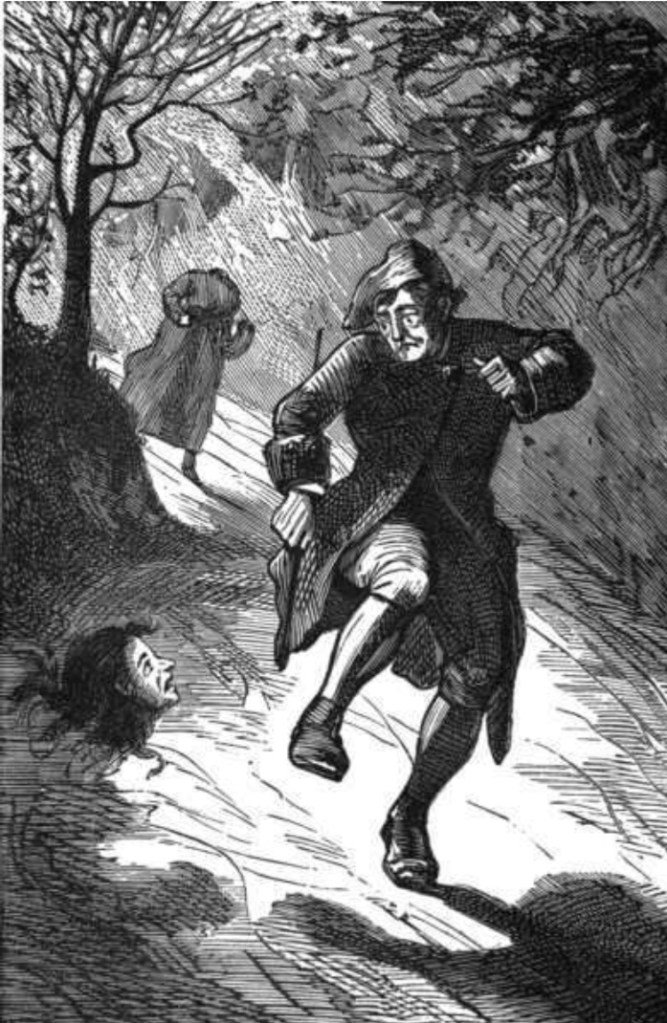
In ‘The Headless Woman’, we see the character Gabriel Fisher chased by a Boggart that takes the form of a headless woman! It is only when he crosses a stream of water does he loose the terrifying creature. Intriguing though that only at a liminal place does Gabriel find safety. Within some Folklore and Fearie lore, it is believed that crossing a bridge or body of water prevents a Feorin, Goblin, Ghost, Demon etc chasing you further, as the water is blessed and cleanses you.
This perhaps stems from the Christian belief in the sacredness of water, and that Jesus was baptised by it, through his cousin, John The Baptist. This notion of Northern Feorin not being able to cross bodies of water and bridges also appears in American folklore too, as we see it as a pivotal point of safety for Ichabod Crane in Washington Irving’s, ‘The Legend Of Sleepy Hollow’.
As I type this, I can hear one of my favourite childhood cartoons (‘The adventures of Ichabod and Mr Toad’, Walt Disney, 1949- available on Disney Plus, for anyone who wants to watch it) echo through my memories, “Once you cross that bridge my friend, the ghost is through, his power ends!”
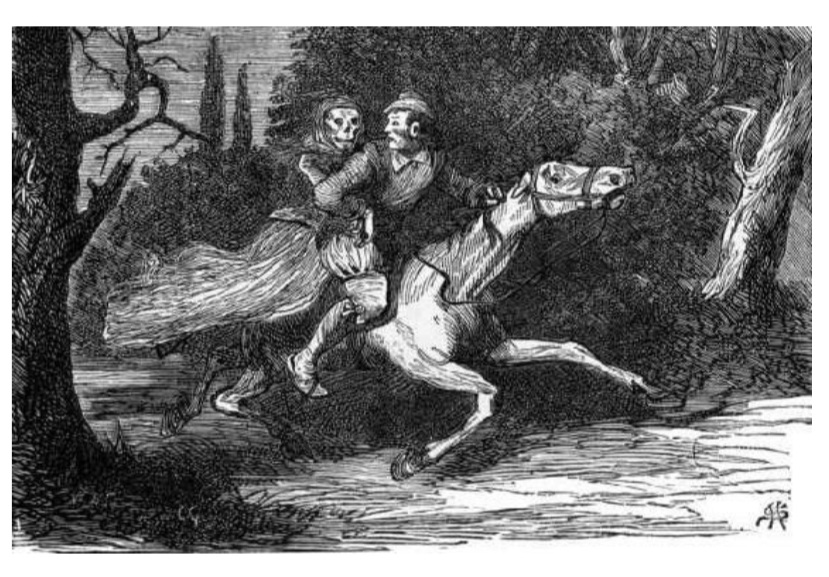
If we look at other stories from ‘Goblin tales of Lancashire’, we also have the infamous tale of ‘The Pillion Lady’. A story that tells the tale Of Humphrey Dobson. A man, who on his way home from a days business at Garstang market and a stop at the local inn, saddles up to go home, only to have a Boggart rider jump upon the back of his horse, and hold on to him by the waist!
“Grinning in a dainty little hood, and almost touching his face, there was a ghastly skull, with eyeless sockets, and teeth gleaming white in the clear moonlight”.
Where the two aforementioned Boggarts take a feminine form, some Boggarts, such as the Boggart of Ince Hall (Wigan, now Greater Manchester, but still very much seen as Lancashire to all locals who refuse to accept the recent boundary changes), and the Boggart in the story ‘The Boggart In Top Attic’ are both invisible and never seen, only heard.
One final example of this shapeshifting creature would be that of the story of ‘The Barcroft Boggart’, in which this house Boggart (who was initially very helpful around the home) is depicted as a shrivelled and barefoot old man.
Banishing Boggarts.
In many a local folklore account, the remedy for getting rid of a Boggart is surprisingly simple. One only has to not only offend the creature by thanking it (even if there is nothing to thank it for, and they have been a proverbial pain in the…), but also invoke a Christian blessing over it. One such example would be;
“I thank you Boggart of this home and land,
and in thanks, I bless you in the name of the
Father, the Son, and the Holy Spirit,
Amen”.
Seemingly, this double insult of both thanking and invoking Christian powers over this pagan-like creature is enough to send it packing for good!
However, for those of you who do not feel comfortable in invoking this original and somewhat ancient banishing technique, you may like the below account which details not an ancient Boggart tale, but a very recent one.
As you will no doubt be aware, where possible, I do like to pepper my blogs with relevant spiritual or supernatural experiences, as I feel it not only gives the reader an insight in to me and my practice, but also demonstrates that supernatural experiences are not limited to Hollywood movies and archaic folklore books, but to the every day person and Witch too! Where I can attest to the fact I have never (thankfully) encountered a Skriker ( a creature which will form part two of this blog), I have experienced what I do think may have been a Boggart.
The Story Of Mr Clickety-Clack.
We had just moved house and had not moved far, just one suburb over. But it was a bigger house and in a quieter area, with less traffic. It also had a garden, and for a family that had spent the first year of the Covid 19 lockdown living in a home without access to a garden, I can tell you, having a garden was a bit of a lifesaver.
With a growing family, this new home was just what we needed! The house felt very settled, and once we redecorated, we wasted no time moving in!
However, it did not take long for strange things to start happening. I think we had only been in the new house about three weeks, when myself and other family members thought we kept seeing shadow like figures in the corner of our eye line (when in the garden), only when we turned our head to see whatever it was properly, there was nothing there.
Not long after this, we began to get strange knocking noises and tapping sounds on windows late at night! Whenever the wall knocking happened, it always seemed to come from the downstairs bathroom roof, which had been built as an extension to the house. An extension that overlapped the garden…
This knocking never sounded like it was coming from the other side of the wall, but from inside the wall and roof itself!
It can’t be an animal, we discussed. The knocking was too rhythmic and there no signs to suggest wildlife were accessing inside the walls or roof.
As for the windows, well, it always sounded like someone tapping to get in!
Being both a Witch and a Medium, I decided to energetically reach out to this creature and see what on earth was going on. However, the more I tried to reach out and make contact, the more it seemed to shift and fold. It was like trying to get hold of a slippery spiritual Eel! This behaviour, in my experience is very different to a traditional ghost, as they will either communicate in some way, or ignore you entirely.
In the end, I decided that as whatever this spirit was doing was not harmful, I would do some watchful waiting, to see what would happen.
Over the coming weeks, the noises became more tiresome and things started to disappear and reappear in the garden. Silly things mainly, like the patio door key or little toys. Not only this, but this entity was now starting to worry guests when they stayed. It can’t be nice to sleep on someone’s sofa and be woken up with sounds like that of someone tapping on the patio door! Alongside these irksome pranks, we were also experiencing this odd ‘clickity-clack’ sound from our bedroom window.
Our bedroom overlooks the downstairs bathroom extension, and as we lay in bed each night, an irritating ‘clickity-clack’ sound would keep us awake! Every time one of us would get up to see what this sound was, we would find that as soon as we pulled open the curtains, the noise would stop, and then start again once we shut the curtains and got into bed. Something was toying with us!
My husband and I decided enough was enough! And realising that our experiences were perhaps symptomatic of a Boggart haunting, I decided to do two things as a plan of attack, especially as communication had failed.
1) I would invoke the banishment method of old local folklore and get rid of this pest by simultaneously thanking and blessing it.
2) I would carry out a full house cleansing (the same one which was last weeks blog feature).
By this point, the home had already had a couple of house cleansings, and had been gifted a blessing when we first moved in, and I suspect that this is why the Boggart was stuck largely outside of the house! It had not occurred to me to energetically cleanse a garden, as nature has a way of cleansing itself. Usually.
So, I cleansed the house, said the blessing (reciting it both inside and outside – thank goodness the neighbours were out lol) and waited.
For about three days we had peace… and then the activity started back up again.
Feeling both frustrated, and somewhat perplexed, I went away to do some additional research on Boggarts and talk to some other local Witches. Much of this research is now in this blog.
It just so happened that during this period, a happy accident occured!
I was doing some general house work when I accidentally knocked a Turkish Nazar that was hanging in my bedroom window. The beautiful blue glass eye that was gifted to me as a protection charm fell through the open window and landed on the downstairs bathroom roof! Neither my husband or I could reach it. Annoyed at myself, I mentally put it to one side and considered asking the Window Cleaner to retrieve it on his next visit.
When it came to going to bed at the end of that day, I was surprised to hear no rappings, tappings, knockings, or the usual chorus of ‘clickety clacks’.
The same thing happened the next night, and then the next, until a week had gone by a no odd occurrences had happened. I wondered if it had been because I had accidentally dropped the pretty blue Nazar out of the window, so I decided to not ask the Window Cleaner to retrieve it. Just as well really, as we have had no Boggart-like activity since! We now live in an extremely quiet (well, excluding the kids, of course) home, and I have done some magickal work on the garden.
I have not cleansed the garden energetically, as I mentioned before, natural spaces tend to have their own way of usually maintaining clean energy (there are some exclusions to this though, for example, Boggart Hole Clough. Along with some infamous cemeteries, such as Highgate Cemetery in North London, and the tragic Covenanters Prison/Kirkyard in Edinburgh, Scotland. The latter also supposedly being the lair of a very active Poltergeist).
However, what I have done, instead of ‘cleansing the garden’, is instead put up various protection charms, plant certain plants and herbs that have protective energies and qualities attached to both them and their plant lore, and also bury certain charms.
We now have a nice quiet, and energetically safe garden, and the fallen glass Nazar still lives upon the extension roof.
Whether it was a Boggart, a ghost, or otherwise, this was an interesting and non frightening experience. If anything, I have learned and awful lot from it.
This is one of the many wonderful things about us Witches, we tend to have a lot of these paranormal experiences, but they are never usually ones that we cannot handle, and when the event or episode is done with, we come away with more experience of spirits of the land, folklore, plant lore, magick, protection, etc etc.
No experience is ever wasted on on a Folk Witch!
Thank you very much for taking the time to read this blog today, I do hope that you enjoyed it and found it useful and insightful! Next weeks premium content blog is part two of this, and together we we will look at the somewhat terrifying Skriker, it’s folklore, myths and relevance to Witches today who work with spirits of the land.
From the time, mists, and distance between us, blessings from me to you.
Zanna
 Diary of a Folk Witch
2 responses to “Folklore And Spirits Of the Land Series: “Where Boggarts Lurk And Skrikers Scream”. Part one.”
[…] Lancashire boasts many a dramatic folk tale, from spectral cats to Boggarts and Skrikers, some of which have already made appearances on this website. Such as: Folklore And Spirits Of the Land Series: “Where Boggarts Lurk And Skrikers Scream”. Part one. […]
LikeLike
[…] spirits such as the poltergeist and the boggart, please feel free to check out my previous blogs Folklore And Spirits Of the Land Series: “Where Boggarts Lurk And Skrikers Scream”. Part one. Alongside it’s second instalment, Folklore And Spirits Of The Land Series: Where Boggarts Lurk […]
LikeLike