
Last week, we took a journey through the infamous folklore of the Boggart, a somewhat complicated trickster creature that hails from the North of England.
We looked at their history, etymology, tales, relevance within Lancashire folklore, and whether or not there was a potential link between it and the Poltergeist.
Where the Boggart can be a nuisance presence and somewhat like a Poltergeist, they are not always dangerous.
Unlike our next guest, the Skriker, whose howling screams are an omen of death for all who encounter it.
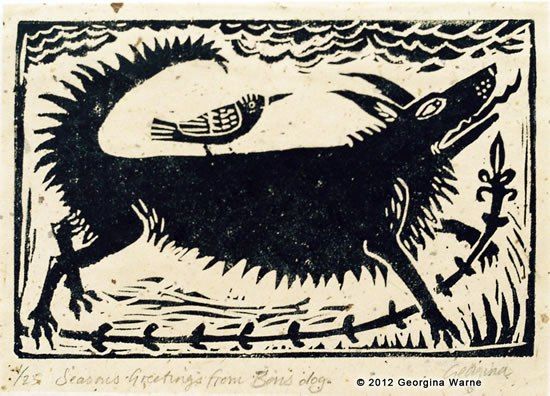
The malevolent Skriker falls quite appropriately into the category of ‘Black dog folklore’ and is the North West of England’s version of other English regional variations of this fearful hound. Such as the Black Shuck of East Anglia, or Old Scratch(y) in parts of the North of England. Another name for the Skriker, here in Lancashire, is that of ‘Old Trash’ (owing to the trash-splash like sound the hound often makes with it’s feet as it walks).
To hear the howling skrikes of this local fiend is to know that the death of either yourself, a loved one, or a friend, is close at hand.
Where some folklore surrounding black dogs around the country can see this spectral hound as a helper or even as a protector, for the most part, they are seen as a bad omen.
Especially here in Lancashire, as I am yet to hear a local story of the Skriker that has a happy ending. In many ways, the Skriker shares a lot of similarities to the Irish Bansidhe. Like the Bansidhe, the Skriker will sound mournful and terrifying howls to signify an impending death. I have often wondered if this is a link formed by Lancashire’s very obvious cultural and ancestral links to Ireland.
Prior to what many have a viewed as the ’emasculation of the county’, Lancashire was a huge and sprawling place that covered all of what is now Manchester, Greater Manchester, and also Merseyside.
Merseyside, and it’s main city of Liverpool, were part of the county of Lancashire until 1974, when it became the metropolitan area that it is now.
Liverpool has a huge connection to Ireland due to it’s high Anglo-Irish population, many of the Irish citizens who came to England during the 1800’s and 20th century did so via Liverpool (my family included). Where many Irish citizens fanned out across the country for work, or even moved on to America, a good number settled within the city of Liverpool, or other parts of the North West for work in the construction and mining industries in and around what was then the entirety of Lancashire.
It’s thought that around 75% of Liverpudlians are of Irish descent, and as for the incredibly famous Scouse accent, well that is predominantly formed from Irish, Welsh and English accents intermingling in this wonderful city. One of Liverpool’s many nicknames is ‘East Dublin’, yet another example of it’s close ties to Ireland.
Knowing that many Irish immigrants settled in Liverpool, as well as other parts of the historic county of Lancashire, it’s entirely possible that both Irish and local regional Folklore mingled and evolved together to form what we now know as the Skriker.
However, spectral black dogs have been a feature in English folklore for hundreds of years, and so pre-date the Irish migration to the county of Lancashire. So where Irish culture and Faerie lore may have possibly influenced local folklore, it by no means fully moulds it.
Great Britain is a nation that is no stranger to invasion and colonisation. As well as being a recent coloniser of other countries, Britain historically, has been the colonised also. From the Roman invasions, to the Saxons, the French defeat of the battle of Hastings, and of course, the Vikings.
It is worth noting that some people have attempted to connect aspects of the Skriker black dog folklore to the Norse God Odin and his two wolves, Geri and Freki.
However, where wolves and dogs are indeed related, I’m not sure that there is a direct folkloric connection between the two. Where it cannot be argued that Norse culture and mythology have indeed had a huge impact upon British culture, for example the names of our days of the week, and names of Northern cities such as York (originally ‘Jorvik’), it’s a bit of a leap to, perhaps, tie a connection between Odin’s wolves, and this lonely spectral hound. If perhaps we were unsure that the Skriker was a dog, then maybe there might be some merit to this theory. Another notable difference is that within Norse mythology, Geri and Freki are very much viewed as companions for Odin, not solitary creatures roaming around issuing death omens. It is also worth noting that both Geri and Freki act almost like guard dogs (or in this case, guard wolves) for Asgard. Where the Skriker does not guard, it stalks people who are either about to die or loose a loved one.
Etymology.
The name Skriker is a regional take on the word ‘Shriek’. In fact, Skriker is one old word from Lancashire dialect that is still commonly used today! Where other pieces of regional slang and dialect are slowly falling by the wayside, it is not uncommon to hear an exasperated parent snap at their child with a “Stop ya Skriking!”.
It is believed that our current word ‘shriek’ is an evolution of the middle English word ‘skrycke’, which in itself is of Scandinavian origin and evolved from the word ‘skreakja’, meaning to ‘screech’ or ‘scream’.
It is interesting that the middle English version of ‘skrycke’ has survived here in Lancashire, albeit with the slightly different spelling of ‘Skrike’. Lancashire dialect was until recently heavily littered with old middle English words, indeed many older generations here in Lancashire still use words such a ‘thee’, ‘thou’ and ‘Feorin’ (Faerie/Fairy).
Some areas in particular, such as Wigan (which was until very recently Lancashire but is now Greater Manchester – not that locals will accept this. They still defiantly, and rightly so, identify as Lancastrians) have dialects that are strong in the use of Middle English.
In Wigan’s case, this would be the famous ‘Wiganese’ dialect, which uses words and phrases such as “Owzthisel?” (How’s thee self/How are you?) and “get thee sen wom!” (Get yourself home!).
Appearance.
In stories of the Skriker, this creature is usually depicted as a huge hound with shaggy black or grey fur. Their eyes are more often than not portrayed as large red or glowing orbs that fix upon their victim, and the Skriker either walks in such a way that it causes a splash like sound upon the ground that it walks upon, or that it glides like a ghost just above the ground. In some cases, the hound is never seen at all and only sensed before a piercing shriek or howl is heard.
Recent Sightings.
One Lancashire based Pagan swears that on one night in late 2020, she heard what she believes to have been the Skriker. The lady in question, who resides in the Clitheroe area said that on this particular night she found it impossible to sleep, and for no obvious reason, she felt an overwhelming sense of anxiety and fear. As she lay in bed, unable to sleep, she said she heard a noise from outside her window, “I’ve no idea what made me do it, but I got out of bed and looked out of the window. At first, I didn’t see anything really. But as my eyes adjusted, I could make out what I think was a fairly big dog! Something about it gave me the creeps, so I closed the curtain’s and turned to go back to bed. But as I got the the bed, I heard this piercing shriek! I’m not lying when I say it made me freeze all over!”.
The screech described by the witness was said to sound ‘inhuman’ and rang out twice. When asked if it could have been a fox screeching in the night, the witness was adamant that it could not have been so. “You get foxes a lot around here, and never in my life have I heard the like of this”. In the days after this possible Skriker incident, the woman’s sister caught Coronavirus and passed away not long after. Whether this was a Skriker or not, the parallels between this recent sighting and historic folkloric ones are strikingly similar.
Another possible Skriker sighting happened during the 1980’s in the Greater Manchester area (formally Lancashire), when a large black dog ran out in front of a car, ‘shrieked’, and caused the car to crash. I can find no evidence on if there were any fatalities caused by the crash (or any in-depth detail regarding this incident), only a reference to the driver thinking they had hit the dog, only to find that when they got out of the car, there was no sign a dog had ever been there. This echoes other black dog and car incidences that happened in and around Manchester. With another supposedly happening in 1996. Again ,a driver believes they have struck a dog, only to find there is no dog to be seen. No in depth details can be found. Just a reference within ‘Black dog folklore’ by Mark Norman (Page 213)

Relevance to Folk Witchcraft.
Some may wonder why I, as Folk Witch, place so much emphasis on areas such as local history, folklore, folk music, customs, and in this case, spirits of the land.
The reason is quite simple really, when one connects to it’s regional ‘ways’ they become braided or ‘married’ to the land. You begin to understand the landscape in which you live and become one with it. To be a Witch is to be connected to land, sea and sky, as well as it’s energies and spirits. On my journey through Witchcraft, I have found that in order to work magick effectively, and to live a life that is spiritually fulfilling, you cannot be separated from your surroundings. You must submerge yourself in in your own local landscape; it’s geography, it’s history, culture, and local land spirits. The magick within ourselves is only part of the formula. The second part comes from the above mentioned sacred connection. The two must ‘marry’ for magick to be conceived and then birthed via workings, ritual and the like.
Some people may view spirits of the land as folklore only. Stories designed to warn people, impart a social morality, or keep children safe from ‘Old Jack’ and the ‘Bogeyman’. And there is some truth to this, I suspect another local legend, that of Jenny Greenteeth is one such example. Jenny (Or Ginny) lures children into bodies of water and drowns them. This is one example, like Old Jack/The Bogeyman that could be examples of old nursery and fireside tales designed to keep young children safe from both drowning in water that they should not be near, and keeping them away from strangers. However, other spirits from folklore are real. They do live upon the land that we share with them. Some, like the Boggart can be worked with as a house spirit (if you know what you’re doing). Local woodland guardians and water spirits can also be worked with and a relationship formed. And even if a Witch decides against working directly with local land spirits, they at least have an understanding of that local spirit’s lore and behaviour through studying both them, and, their documented encounters.
There are some creatures however who it is not wise to work with, the Skriker being one of them. In cases such as this, it is better to just understand the lore and hopefully avoid this omen of death. Knowledge is power and wisdom, and forewarned is forearmed.
A classic tale of ‘The Skriker’.
Below is the story of the Skriker taken from James Bowker’s 1883 book ‘Goblin tales of Lancashire’. I hope you find it as a spine chilling and as eerie as I do, the entire book is worth of a read.
“On a fine night, about the middle of December, many years ago, a sturdy-looking young fellow left Chipping for his cottage, three or four miles away, upon the banks of the Hodder. The ground was covered with snow, which in many places had drifted into heaps, and the keen frost had made the road so slippery that the progress he made was but slow. Nature looked very beautiful, and the heart of the rustic even was touched by the sweet peacefulness of the scene. The noble old Parlick, and the sweeping Longridge, with its fir-crowned Thornley Height and Kemple End, stood out boldly against the clear sky, and the moon shed her soft silvery light into the long silent valley, stretching away until its virgin paleness mingled with the shadows and the darkness of the distant fells beyond Whitewell.
All was still, save when the sighing wind rustled gently through the frosted branches of the leafless trees by the roadside, and shook down upon the wayfarer a miniature shower of snow; for even the tiny stream, so full of mirth and music in the summer time, had been lulled to sleep by the genius of winter; and the cottagers, whose little houses, half-hidden by the rime, seemed hardly large enough for the dwellings of dwarfs, had been snugly sleeping for hours. Adam was by no means a timid or nervous being, but there was a nameless something in the deathly silence which oppressed, if it did not actually frighten, him; and although he sang aloud a verse of the last song he had heard before he left the kitchen of the Patten Arms, his voice had lost its heartiness. He earnestly wished himself safely across the little bridge over the brook; but he was yet some distance from the stream when the faint chimes of midnight fell upon the air. Almost immediately after the last stroke of twelve had broken the silence a cloud passed over the face of the moon, and comparative darkness enveloped the scene; the wind, which before had been gentle and almost noiseless, began to howl amid the boughs and branches of the waving trees, and the frozen snow from the hedgerows was dashed against the wayfarer’s face. He had already begun to fancy that he could distinguish in the soughing of the wind and the creaking of the boughs unearthly cries and fiendish shouts of glee; but as he approached the dreaded stream his courage almost entirely failed him, and it required a great effort to keep from turning his back to it, and running away in the direction of the little village at the foot of Parlick. It struck him, however, that he had come a long distance; that if he did go back to the Patten Arms the company would be dispersed, and the inmates asleep, and, what was more effective than all, that if he could only cross the bridge he would be safe, the Greenies, Boggarts, and Feorin not having power over any one who had passed over the water. Influenced by this thought, yet with his knees trembling under him, he pushed forward with assumed boldness, and he had almost reached the bridge when he heard the noise of passing feet in the crunching snow, and became conscious of the presence of a ghastly thing he was unable to see. Suddenly a sepulchral howl brought him to a stop, and, with his heart throbbing loudly enough to be heard, he stood gazing fixedly into the darkness. There was nothing to be perceived, however, save the copings of the bridge, with their coverings of grime; and he might have stood there until daylight had not another cry, louder and even more unearthly and horrible than the preceding one, called him from his trance. No sooner had this second scream died away than, impelled by an irresistible impulse, he stepped forward in the direction whence the noise had come. At this moment the moon burst forth from behind the clouds which had for some time obscured her light, and her rays fell upon the road, with its half-hidden cart-tracks winding away into the dim distance; and in the very centre of the bridge he beheld a hideous figure with black shaggy hide, and huge eyes closely resembling orbs of fire. Adam at once knew from the likeness the dread object bore to the figure he had heard described by those who had seen the Skriker, that the terrible thing before him was an Ambassador of Death. Without any consciousness of what he was doing, and acting as though under the sway of a strange and irresistible mesmeric influence, he stepped towards the bridge; but no sooner did he stir than the frightful thing in front of him, with a motion that was not walking, but rather a sort of heavy gliding, moved also, slowly retreating, pausing when he paused, and always keeping its fiery eyes fixed upon his blanched face. Slowly he crossed the stream, but gradually his steps grew more and more rapid, until he broke into a run. Suddenly a faint knowledge of the horrible nature of his position dawned upon him. A little cottage stood by the roadside, and from one of its chamber-windows, so near to the ground as to be within his reach, a dim light shone, the room probably being occupied by a sick person, or by watchers of the dead. Influenced by a sudden feeling of companionship, Adam tried to cry out, but his tongue clave to his parched mouth, and ere he could mumble a few inarticulate sounds, scarcely audible to himself, the dwelling was left far behind, and a sensation of utter loneliness and helplessness again took possession of him. He had thus traversed more than a mile of the road, in some parts of which, shaded by the high hedgerows and overhanging boughs, the only light seemed to him to be that from the terrible eyes, when suddenly he stumbled over a stone and fell. In a second, impressed by a fear that the ghastly object would seize him, he regained his feet, and, to his intense relief, the Skriker was no longer visible. With a sigh of pleasure he sat down upon a heap of broken stones, for his limbs, no longer forced into mechanical movement by the influence of the spectre’s presence, refused to bear him further. Bitterly cold as was the night, the perspiration stood in beads upon his whitened face, and, with the recollection of the Skriker’s terrible eyes and horrible body strong upon him, he shook and shivered, as though in a fit of the ague. A strong and burly man, in the very prime of life, he felt as weak as a girl, and, fearing that he was about to sink to the ground in a swoon, he took handfuls of the crisp snow and rubbed them upon his forehead. Under this sharp treatment he soon revived a little, and, after several unsuccessful efforts, he succeeded in regaining his feet, and resumed his lonely journey. Starting at the least sough of the breeze, the faintest creak of a bending branch, or the fall of a piece of frozen rime from a bough, he slowly trudged along. He had passed the quaint old house at Chaigely, the sudden yelp of a chained dog in the court-yard giving him a thrill of horror as he went by, and he had reached the bend in that part of the road which is opposite the towering wood-covered Kemple End. A keen and cutting blast swept through the black firs that crowned the summit, and stood, like solemn sentinels, upon the declivity. There was a music in the wind mournful as a croon over the corpse of a beautiful woman, whose hair still shimmers with the golden light of life; but Adam heard no melody in the moaning sighs which seemed to fill the air around. To him, whose soul was yet under the influence of the terror through which he had so recently passed, the sounds assumed an awful nature; whilst the firs, standing so clearly defined against the snow, which lay in virgin heaps upon the beds of withered fern, seemed like so many weird skeletons shaking their bony arms in menace or in warning. With a suddenness that was more than startling, there was a lull, and the breeze ceased even to whisper. The silence was more painful than were the noises of the blast battling with the branches, for it filled the breast of the solitary wayfarer with forebodings of coming woe. At the point he had reached the road sank, and as Adam stepped into the almost utter darkness, caused by the high banks, to which clung masses of decayed vegetation, beautified by the genius of winter into white festoons, again and again the terrible shriek rang out. There was no mistaking the voice of the Skriker for that of anything else upon earth, and, with a sickly feeling at his heart, Adam slowly emerged from the gloom, and, in expectation of the appearance of the ghastly figure, passed on. He had not to wait long, for as he reached the old bridge spanning the Hodder, once more he saw, in the centre of the road, about midway of the stream, the same terrible object he had followed along the lane from the brook at Thornley. With a sensation of terror somewhat less intense than that which had previously influenced him, he again yielded to the power which impelled him forward, and once more the strange procession commenced, the Skriker gliding over the snow, not, however, without a peculiar shuffling of its feet, surrounded, as they were, by masses of long hair, which clung to them, and deadened the sound, and Adam following in his mechanical and involuntary trot. The journey this time, however, was of but short duration, for the poor fellow’s cottage was only a little way from the river. The distance was soon traversed, and the Skriker, with its face towards the terrified man, took up its position against the door of the dwelling. Adam could not resist the attraction which drew him to the ghastly thing, and as he neared it, in a fit of wild desperation, he struck at it, but his hand banged against the oak of the door, and, as the spectre splashed away, he fell forward in a swoon. Disturbed by the noise of the fall, the goodwife arose and drew him into the cottage, but for some hours he was unable to tell the story of his terrible journey. When he had told of his involuntary chase of the Skriker, a deep gloom fell over the woman’s features, for she well knew what the ghastly visit portended to their little household. The dread uncertainty did not continue long, however, for on the third day from that upon which Adam had reached his home the eldest lad was brought home drowned; and after attending the child’s funeral, Adam’s wife sickened of a fever, and within a few weeks she too was carried to Mytton churchyard. These things, together with the dreadful experience of the journey from Chipping, so affected Adam that he lost his reason, and for years afterwards the sound of his pattering footsteps, as in harmless idiotcy, with wild eyes and outstretched hands, he trotted along the roads in chase of an imaginary Boggart, fell with mournful impressiveness upon the ears of groups gathered by farm-house fires to listen to stories of the Skriker.
Thank you for reading today’s blog and I hope you enjoyed it!
Next week’s blog will be discussing ‘pin and needle magick’, where we shall be looking at it’s Witchlore, applications within magick, historic examples, as well as two example workings of how pin and needle magick can be used in both healing and harmful magick. Please note that the two workings in next weeks blog are for academic and example pieces only. What you, the reader do with these examples is down to yourself and your own individual practices, as author of the blog I take no responsibility for any actions taken by the reader.
From the time, mists, and distance between us, blessings from me to you.
 Diary of a Folk Witch
One response to “Folklore And Spirits Of The Land Series: Where Boggarts Lurk And Skrikers Scream (Part 2)”
[…] In previous blogs I have discussed and detailed mischievous and outright dangerous house spirits such as the poltergeist and the boggart, please feel free to check out my previous blogs Folklore And Spirits Of the Land Series: “Where Boggarts Lurk And Skrikers Scream”. Part one. Alongside it’s second instalment, Folklore And Spirits Of The Land Series: Where Boggarts Lurk And Skrikers Scream (Part 2) […]
LikeLike